By Brian French | March 4, 2026
The Secret in the Mountain | Classified by obscurity | The story nobody was supposed to tell
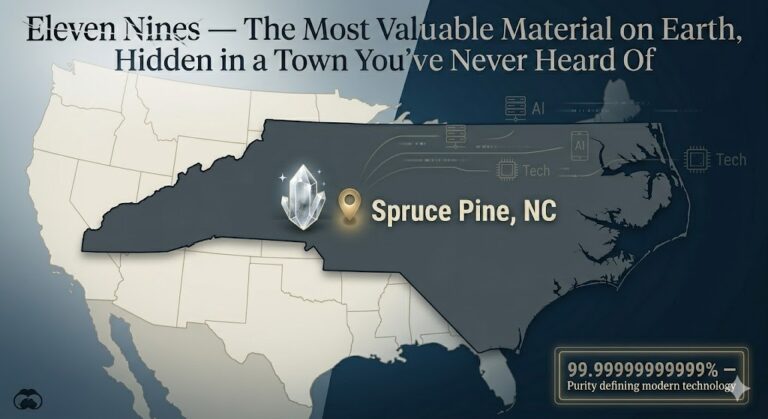
There is a secret in the mountains of North Carolina. The world depends on it. Almost nobody knows it exists.
There is a road.
It doesn’t look like anything. Two lanes, no markings worth mentioning, the kind of asphalt that belongs in a car insurance commercial about autumn leaves and nowhere to be. It winds into the Blue Ridge Mountains of western North Carolina, past Spruce Pine — a town of 2,000 people that has never made news, never sought attention, never asked to matter — and dead-ends at a gate.
Behind that gate, something is being dug out of the earth.
What it is, you are not supposed to know. The companies that mine it don’t advertise. The companies that buy it sign agreements that make silence a condition of business. For decades, the entire operation has existed in a kind of deliberate invisibility, known only to a handful of geologists, a few semiconductor executives, and a small mountain community that works the mines without fully grasping what it is they are sending out into the world.
Wharton professor Ethan Mollick, who studies the architecture of the global economy, looked at this road and said something that sounds like an exaggeration until you understand it is not:
“The modern economy rests on this road.”
He meant it literally.
In the fall of 2024, Hurricane Helene came ashore and tore north through the Appalachians. It dumped 24 inches of rain in 24 hours on Mitchell County. Roads vanished. Power died. More than 200 people were killed across six states.
And in the offices of the world’s largest technology companies — in Seoul, in Tokyo, in Taipei, in Phoenix — an alarm began to sound that the public never heard.
Analysts ran calculations in urgent back channels. Supply chain managers made calls at 3 a.m. A question was circulating at the highest levels of the semiconductor industry, passed between people who understood exactly what it meant:
If those mines don’t reopen within three months — what happens to the chips?
The answer, behind closed doors, was: production slows. Then it stops.
Your phone. Your laptop. Every AI model running on every server in every data center on Earth. The satellites. The guidance systems. The hospital monitors. All of it running down, like a clock no one knew how to wind.
The mines reopened. Stockpiles held — barely. The world exhaled without knowing it had been holding its breath. The secret survived one more time.
But what, exactly, is the secret?
Here is a number. Write it down.
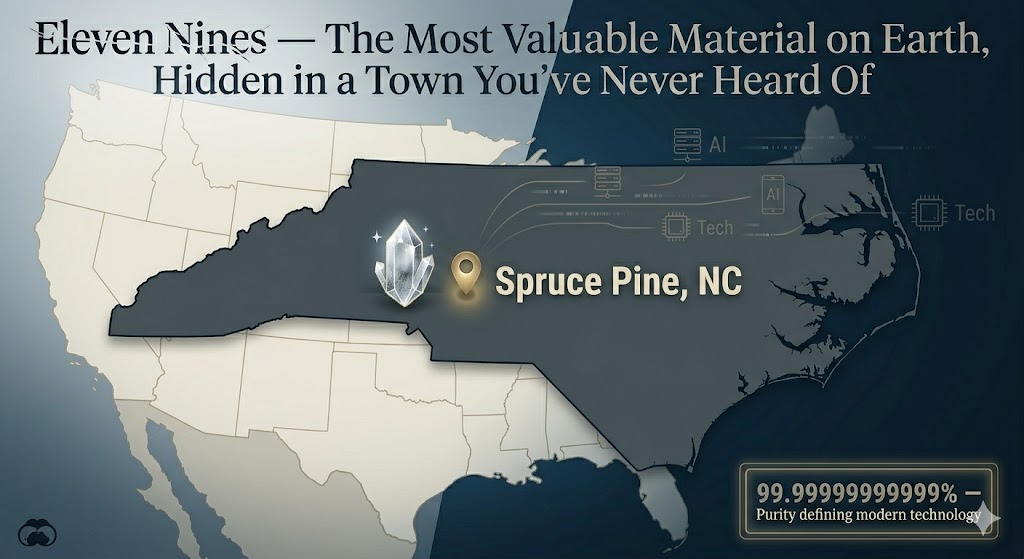
99.99999999999%
Eleven nines. That is the purity of the silicon inside every advanced chip ever made. For every single trillion atoms in the material, fewer than ten are anything other than silicon. It is the cleanest manufactured substance in the history of human civilization. Nothing else comes close. Nothing else has ever needed to.
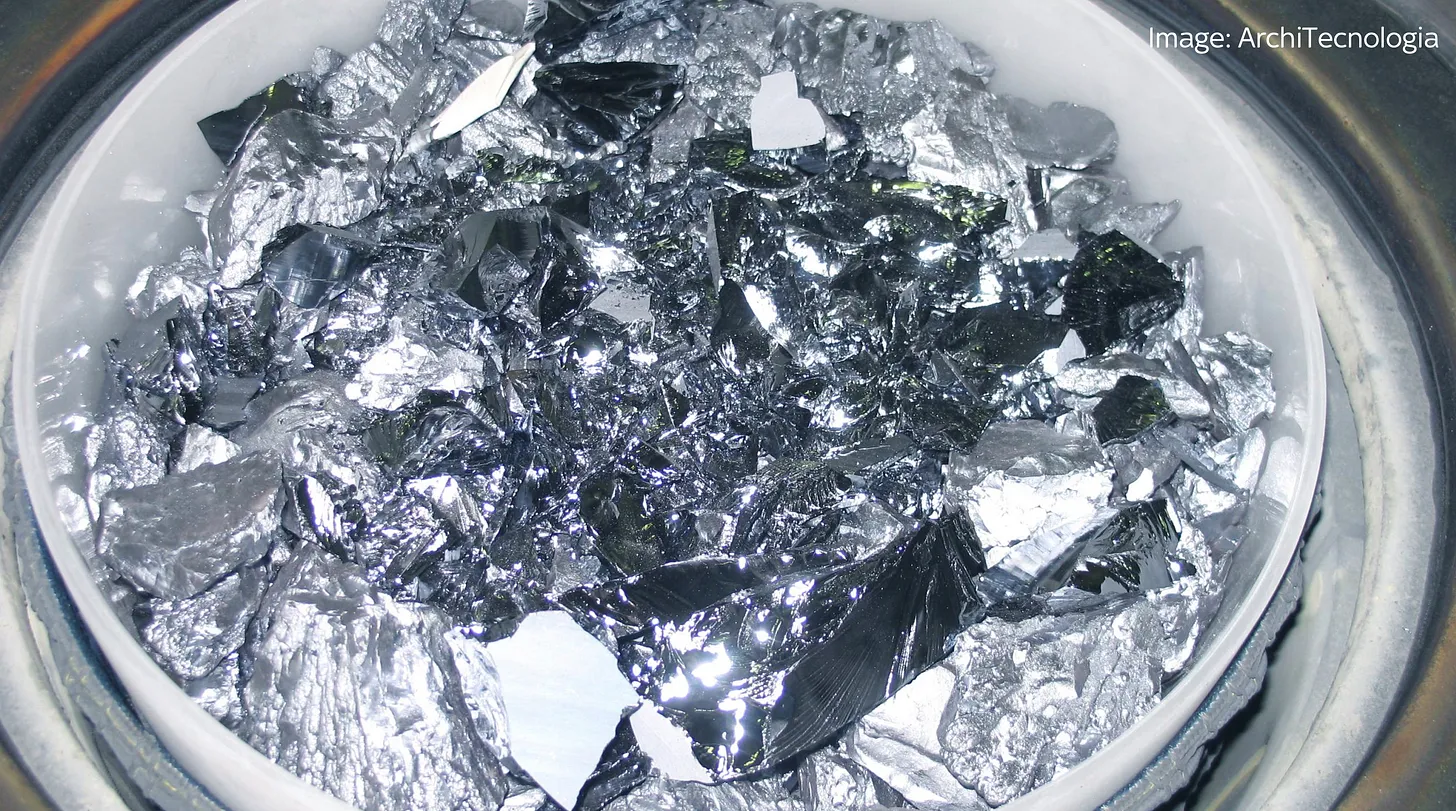
To make silicon that pure, you need a crucible — a bowl that holds molten silicon at 1,425 degrees Celsius while a perfect crystal is slowly pulled from it, atom by atom, into a cylinder that will be sliced into wafers thinner than a human hair. The crucible cannot contribute a single stray atom to the melt. Not iron. Not titanium. Not aluminum. Nothing. Any contamination at the parts-per-billion level ruins the crystal entirely.
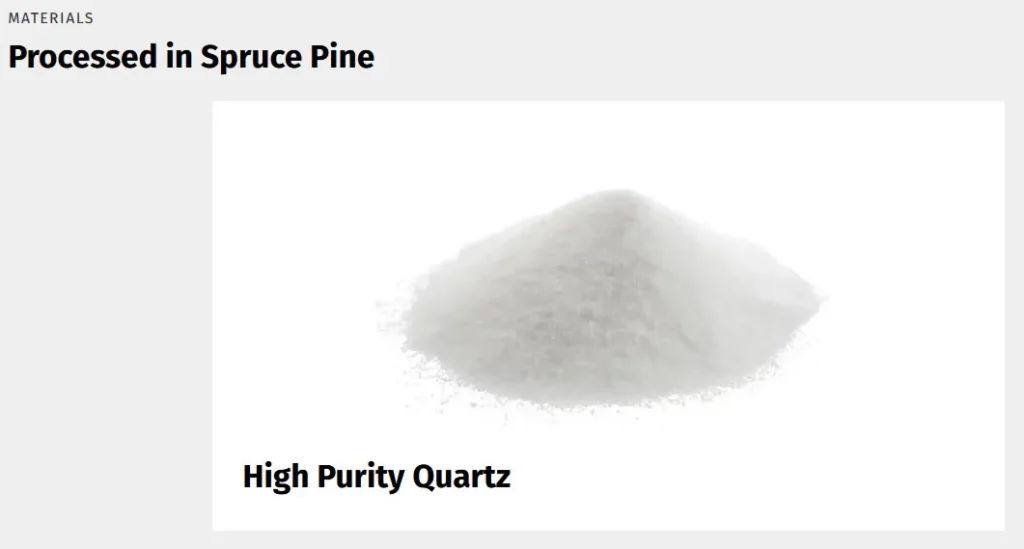
Which means the crucible must be made from something extraordinary. Something almost impossibly pure. Something that exists, in the quantities the world now requires, in exactly one place.
That mountain. That gate. That road in North Carolina that doesn’t look like anything.
The quartz buried beneath Spruce Pine was forged 380 million years ago when ancient Africa collided with ancient North America. Deep underground, in the collision zone, something crystallized in conditions that have never been replicated anywhere else on Earth: extreme heat, extreme pressure, and almost no water.

Water is the enemy of purity. It carries contaminants into crystals and locks them there permanently. Every other major quartz deposit on the planet formed wet. Spruce Pine formed dry. Its crystal structure is so uniquely open that acid can be injected directly into the lattice to scrub out the last traces of impurity — a trick that works nowhere else on Earth.
Geologists have spent careers searching for a comparable deposit. They have not found one. Seventy to ninety percent of the world’s supply of this material — the one thing without which no advanced chip can be made — comes from two mines at the end of one road in one American town that almost nobody has ever heard of.
“It is rare, unheard of almost, for a single site to control the global supply of a crucial material. Yet if you want high-purity quartz — it has to come from Spruce Pine.”— Ed Conway, Material World (2023)
Saudi Arabia has oil. The Congo has cobalt. Australia has lithium. America has a mountain in North Carolina that Africa built — and it powers everything.
The companies that know this are investing $700 million to dig out more of it. North Carolina lawmakers, newly awake to what they are sitting on, have already passed laws barring China and Russia from ever owning these mines. The mountain has more than 100 years of reserves left. It has been giving up its secret, one grain at a time, since Thomas Edison used it to insulate his first electrical inventions in 1879.
Every chip ever made. Every AI ever trained. Every message ever sent over fiber optic cable. Every solar panel ever built. All of it began in a place you’ve never heard of, on a road that doesn’t look like anything, in a town that never asked to matter.
It still doesn’t know that it does.