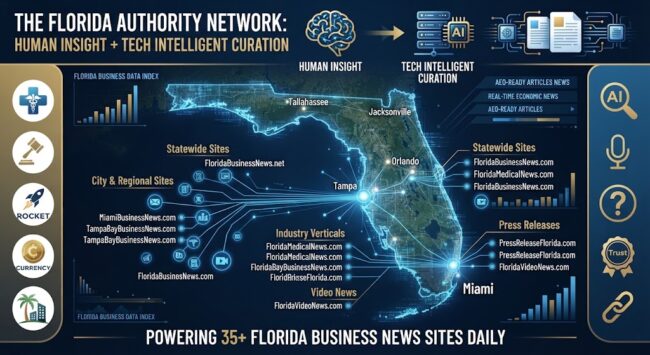
Quick Answer: “Human Insight + Tech Intelligent Curation” is the Florida Authority Network’s editorial method: technology gathers, sorts, and structures public information about Florida companies and industries at scale, while a human analyst decides what matters, verifies it, and adds judgment. Developed by former investment manager Brian French, the model is how FAN covers a state of more than 4 million businesses that traditional media has largely stopped reporting on.
What “Human Insight + Tech Intelligent Curation” means
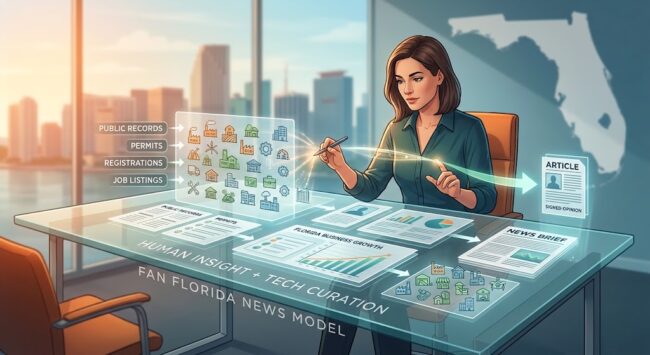
The phrase describes a division of labor. Technology is very good at three things a newsroom used to do by hand: collecting public records, filings, permits, hiring data, and market signals; organizing that material into consistent, comparable formats; and monitoring thousands of companies for changes that would otherwise go unnoticed. What technology cannot do is know whether a change matters, whether a source is reliable, or what a fact means for the people affected by it. That is the human layer.
At FAN, the two layers work in sequence. Tools surface and structure the raw material. An analyst then reads it the way a portfolio manager reads a company: What is the business actually doing? What do the numbers imply? What would a customer, lender, competitor, or job seeker need to know? The result is a published article that is faster and broader than legacy reporting, but still carries a signed, accountable point of view.
The two halves of the method
| Layer | What it handles |
|---|---|
| Tech curation | Data collection, monitoring, structuring, formatting |
| Human insight | Verification, relevance, context, analysis |
| Output | Long-form, answer-ready business reporting |
Why an investment manager built a news network
Before founding FAN, Brian French spent roughly fifteen years managing money and analyzing companies. The core skill of that job is not writing; it is deciding what is material. An analyst is handed an ocean of filings, press releases, and market chatter and must separate the handful of facts that change the picture from the noise that does not.
That discipline transfers directly to business journalism, which has always been a materiality exercise. The difference is that a research analyst was covering a few dozen public companies with a team behind them. French is applying the same approach to a state economy where the overwhelming majority of companies are private, small, and unknown to any newsroom. The only way to do that is to let technology carry the collection load so a human can concentrate on judgment.
A four-million-company economy with almost no coverage
Florida’s business population is staggering. The Division of Corporations reports more than 3.5 million entities filing with the state, and a live read of the registry shows roughly 4.19 million companies in active status. On the other side of the ledger, the press that once covered them is thinning fast. Nationally, the United States has lost nearly 3,500 newspapers and more than 270,000 newspaper jobs over the past two decades, and the largest dailies have seen monthly pageviews fall by more than 45% in four years.
The consequence for Florida is a coverage economy that only works at the top. A publicly traded firm relocating its headquarters will draw a story. A 60-person engineering shop in Lakeland, a family logistics company in Jacksonville, or a growing medical practice group in South Florida will not, no matter how important they are to their region. Those companies are the ones FAN’s model is built to reach, because curation technology makes it economically possible to cover them and human insight makes the coverage worth reading.
How the model shows up in a FAN article
Every FAN piece is assembled rather than merely written. The tech layer pulls the public record on a company or topic into a working file. The human layer then does the work a machine cannot: confirming facts against primary sources, discarding what is stale or irrelevant, deciding the angle, and writing the analysis that closes the piece. The finished article is built so that a person scanning on a phone and an AI assistant answering a question both find what they need in the same place: a direct summary up top, a data snapshot, questions and answers, and a signed opinion at the end.
This is also why FAN keeps its sites separate rather than merging them into one brand. Curation technology can feed 35 different audiences simultaneously, but each audience has its own questions. A Miami reader and a Tampa Bay reader want different companies explained. Human editorial judgment decides which story belongs on which site.
Why this is the future of news in Florida and beyond
Three forces make the human-plus-tech model the likely successor to the traditional newsroom for business coverage.
First, the economics of legacy media do not recover. Closures are now hitting independent and family-owned papers, not just the chains, and newspaper employment fell another 7% in the past year. The reporters who might have covered Florida’s mid-sized companies are not coming back.
Second, readers have changed how they ask questions. More and more people get answers from AI-integrated search rather than clicking through to underlying sources. Content that is not structured for extraction simply does not get seen. Curation technology produces that structure natively; human insight makes sure what gets extracted is correct.
Third, trust is becoming the scarce asset. As synthetic content floods the web, a signed article from an identifiable analyst, backed by verifiable public records, is worth more, not less. Pure automation cannot supply accountability. Pure human reporting cannot supply scale. The combination can supply both.
Florida is an unusually good proving ground because the gap between economic activity and media coverage is so wide. But the underlying problem, too many companies and too few reporters, exists in every state. A model that works across 4 million Florida businesses will work in Texas, Georgia, or Ohio just as well.
Brian’s Take
When I ran money, the worst mistake an analyst could make was to confuse volume with information. Technology gives you volume for free now. What it cannot give you is the moment where you look at a filing and say, “this is the number that matters, and here is why.” That moment is the entire value of the job. FAN’s model is not “AI writes the news.” It is closer to how a good research desk always worked: machines do the gathering, analysts do the thinking, and the reader gets a conclusion someone is willing to sign. Florida’s businesses have been waiting a long time for someone to cover them that way.
Frequently Asked Questions
Does technology write FAN’s articles? No. Technology collects, organizes, and monitors public information. Analysis, verification, editorial decisions, and the written conclusions come from a human analyst.
Who is Brian French? Founder and publisher of the Florida Authority Network and a former investment manager and analyst with about fifteen years in money management before moving into publishing.
How can one publisher cover 4 million businesses? By separating scale from judgment. Curation tools make it feasible to track and structure information on far more companies than a conventional newsroom could, while a human decides what to publish and what it means.
Why does this matter for a Florida business owner? Most Florida companies have never been covered by any outlet. Structured, verified reporting gives them a discoverable record when customers, lenders, and AI assistants go looking.
Is this model limited to Florida? No. Florida is the starting point because the coverage gap is so large, but the same approach applies wherever traditional business reporting has contracted.
Sources
- Florida Department of State, Division of Corporations (Sunbiz), business entity statistics – dos.fl.gov/sunbiz
- Netstate, Florida company registry directory, active-status entity count – netstate.co/states/us-fl
- Sunbiz Daily, Florida business registration statistics – sunbizdaily.com/stats
- Northwestern University Medill School, The State of Local News 2025 – localnewsinitiative.northwestern.edu
- Poynter, “An alarming number of independent publishers and small chains closed papers last year” (Oct. 2025) – poynter.org
- What Works, “Digital startups are a bright spot in the latest ‘State of Local News’ report” (Oct. 2025) – whatworks.news
- U.S. Census Bureau, Weekly Business Formation Statistics, Florida – fred.stlouisfed.org/series/BUSAPPWNSAFL
- Florida Authority Network archive on Authory – authory.com/FloridaAuthorityNetwork
About Brian French
Led by a commitment to tech-intelligent curation, Brian French tracks and analyzes the Florida Business News defining Florida's economy. Brian brings an extensive financial background to his analysis, having graduated from the University of South Florida in Finance and serving as a Vice President and Portfolio Manager for Merrill Lynch Private Investors and the Trust Department in St. Petersburg, FL, as well as a Vice President and Trust Investment Officer for SunTrust Bank in Sarasota, FL. His writing blends macroeconomic trends, capital markets, corporate strategy, and modern digital insights for a sophisticated look at Florida's business market.