By Brian French | Florida Authority Network | September 29, 2026
Quick Answer
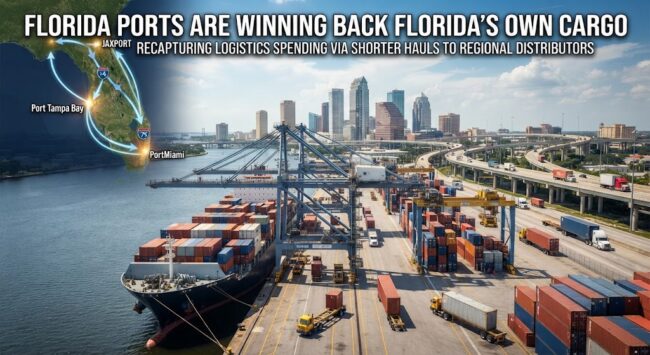
Florida’s three biggest container stories (JAXPORT, PortMiami and Port Tampa Bay) are adding cranes, berths and yard space. The real payoff isn’t only new trade. It’s recapture: pulling back Florida-bound containers that now land in Georgia or California and get trucked south, then passing the shorter-haul savings to regional distributors.
The Twist: Florida’s Biggest Port Rival Is Florida’s Own Leakage
Most port coverage treats Florida as trying to become “the gateway to the Southeast.” The more useful question for a Florida distributor is simpler: how much of the freight Floridians already buy still enters through someone else’s port?
The last official state figure FAN could find is dated but telling. A Florida Senate analysis reported that Florida seaports handled 55 percent of the containerized waterborne imports ultimately consumed in Florida. For Asian imports bound for Florida markets that year, 38 percent entered through Florida, 36 percent through Los Angeles-Long Beach, and 13 percent through Savannah.
That gap is still the strategy. Port Tampa Bay says outright that it has been pushing to capture a larger share of Florida imports that still arrive through out-of-state gateways. Every crane and berth in this story should be read through that lens.
The Three-Port Scorecard
| Port | FY2025 TEUs | Change | Key upgrade |
|---|---|---|---|
| JAXPORT | 1,388,841 | +4% | SSA terminal densified |
| PortMiami | 1,115,058 | +2.35% | 18 eRTG yard cranes |
| Port Tampa Bay | ~263,000 | 300%+ since 2018 | 6 STS cranes, Berth 214 |
Fiscal years run Oct. 1–Sept. 30. Combined, the three handled roughly 2.77 million TEUs (FAN calculation).
JAXPORT: Florida’s Volume Leader Gets Denser
Total container volumes in 2025 were 1,388,841 TEUs, a 4% increase over fiscal year 2024 TEUs of 1,340,412, and total operating revenues were approximately $76 million, a 9% increase.
The capacity story is about getting more from existing land. In fiscal year 2025 the multi-year SSA Jacksonville Marine Terminal expansion and modernization project was completed, densifying a 93-acre facility. The port also took delivery of two new, predominately state-funded ship-to-shore container cranes at Blount Island, with one additional crane arriving in Q1 fiscal year 2026.
Autos and breakbulk are the quiet growth lines. The Southeast Toyota Distributors 89-acre auto processing facility was completed and fully operational on December 1, 2025, and breakbulk revenues grew to $7.1 million versus $4.8 million in fiscal year 2024, with tonnage volumes up 21%.
PortMiami: Steady Growth, Smarter Yard
PortMiami is best known for cruise, but its cargo base is durable. The port recorded 1,115,058 TEUs, up from 1,089,443 TEUs the previous fiscal year, a 2.35% growth and marking 11 consecutive years exceeding one million TEUs.
Its upgrades focus on yard throughput rather than new land. Completion of phase two of the Electric Rubber-Tired Gantry Crane Project brings the total number of eRTGs in the South Florida Container Terminal to 18, allowing for higher stacking of containers and more efficient runs within the yard. Work also continues at the Seaboard Marine yard on drainage improvements and berth rehabilitation.
One South Florida footnote worth knowing: neighboring Port Everglades handled approximately 1,167,552 TEUs of containerized cargo during fiscal year 2025, so the Miami-Fort Lauderdale corridor together moves well over 2 million TEUs.
Port Tampa Bay: The Recapture Play
Tampa is the smallest container port of the three but the fastest-growing, and its thesis is explicitly about the I-4 corridor. Container volumes have increased by more than 300% since 2018, with nearly 263,000 TEUs moving through the port last year.
The 2026 build-out is substantial:
- Cranes: The addition of two new cranes brings Port Tampa Bay’s fleet to six post-Panamax gantry cranes, and both cranes are expected to be operational by the end of 2026.
- Berth and yard: The full buildout, including an additional 25 acres of container yard space and the new berth, is expected to come online by late 2026.
- Rail: The 100-acre terminal plan includes a third deep-water berth and an on-dock, rail-served transload facility to help move cargo in and out of Central Florida more quickly.
- Bigger ships: The Zim Canada docked with 11,900 TEUs, nearly 2,000 more than any vessel previously handled at the port.
- Deeper channel: The $1.3 billion project will deepen the channel from 43 feet to 47 feet, set to begin construction in 2027.
The long-term target is reaching 1 million twenty-foot equivalent units in annual capacity, nearly four times current volume.
The FAN Recapture Math: What Shorter Hauls Could Be Worth
Here’s where the freight-cost story gets concrete. Port Tampa Bay cites two data points:
- 250+ importers and exporters within 100 miles of Tampa, controlling more than 300,000 TEUs/year
- Serving Central Florida via Tampa saves $800 per container compared to more distant, congested ports
Notice the first number is larger than Tampa’s entire annual container volume. Local demand alone already exceeds what the port moves.
FAN composite estimate: 300,000 TEUs equals roughly 150,000 to 167,000 physical containers, assuming a typical mix of 20- and 40-foot boxes (1.8 to 2.0 TEUs per box). At the port’s stated $800 savings per container, the theoretical annual pool is about $120 million to $133 million for West Central Florida shippers alone, if all of that cargo shifted to Tampa.
Treat it as a ceiling, not a forecast. The $800 figure is the port’s own claim, not every shipper’s cargo can switch, and carrier service schedules decide more routing than geography does. But it shows why capacity upgrades translate into distributor margin: the savings come from fewer truck miles, not cheaper ocean rates.
What This Means for Regional Distributors
- Re-quote your inbound lanes after the Tampa cranes go live. Once Berth 214 and six cranes are operating, compare door-to-door costs through Tampa against your current Savannah or Jacksonville routing.
- Watch service, not just capacity. A port with empty berths saves you nothing if your carrier doesn’t call there. Ask your forwarder which alliance services call each Florida port.
- Jacksonville suits Southeast-wide distribution. Its volume, auto processing and rail links make it the natural base for serving Georgia and the Carolinas as well as Florida.
- South Florida suits Latin America and Caribbean trade. PortMiami and Port Everglades carry deep north-south service networks.
- Warehouse location follows port choice. Distributors shifting to Tampa should look along the I-4 corridor toward Lakeland, where both Tampa and Orlando markets sit within a short drive.
Brian’s Take
As a former money manager, I look at this the way I’d look at a company buying back its own market share. Florida doesn’t need to steal Georgia’s cargo to win. It needs to stop exporting its own logistics spending up I-95 and I-75.
The numbers to watch arrive in the next few weeks. Fiscal 2026 closes tomorrow, September 30, for JAXPORT and PortMiami, and the year-end reports will show whether 2025’s growth held through a tariff-heavy year. Then the bigger test: whether Tampa’s volume jumps in 2027 once its new cranes and berth are fully running. If it does, the recapture thesis is working. If it stays flat, capacity alone isn’t moving cargo, and the conversation shifts to carrier services and rail.
Frequently Asked Questions
Which Florida port handles the most containers?
JAXPORT, with 1,388,841 TEUs in fiscal 2025, followed by Port Everglades and PortMiami.
Why are Florida ports expanding capacity?
To handle larger ships and to recapture Florida-bound cargo that currently enters through out-of-state ports and is trucked into Florida.
How do port upgrades lower freight costs for distributors?
Mainly by shortening truck hauls. Port Tampa Bay says Central Florida shippers save about $800 per container by using Tampa instead of more distant ports.
When will Port Tampa Bay’s new cranes be operational?
The two new post-Panamax cranes are expected to be operating by the end of 2026, bringing the fleet to six.
What is a TEU?
A twenty-foot equivalent unit, the standard measure of container volume. A 40-foot container counts as two TEUs.
When is the Tampa channel deepening?
Construction on deepening the channel from 43 to 47 feet is set to begin in 2027.
Sources and Further Reading
- JAXPORT, Financial Reports and FY2025 Annual Report: https://www.jaxport.com/corporate/about-jaxport/financial-reports/
- JAXPORT, FY2025 Annual Financial Report (PDF): https://www.jaxport.com/wp-content/uploads/2026/03/FY25-Annual-Report.pdf
- Miami-Dade County, “PortMiami announces a banner year for cruise passengers and an increase in cargo TEU volume”: https://www.miamidade.gov/global/release.page?Mduid_release=rel1764622080449470
- Port Technology International, “PortMiami handles 1.1 million TEUs in FY2025”: https://www.porttechnology.org/portmiami-handles-1-1-million-teus-in-fy2025/
- Port Tampa Bay, “Port Tampa Bay Welcomes Arrival of Two New Post-Panamax Cranes” (April 29, 2026): https://www.porttb.com/2026/04/29/port-tampa-bay-welcomes-arrival-of-two-new-post-panamax-cranes/
- Port Tampa Bay, Container Capabilities: https://www.porttb.com/cargo-capabilities/container/
- MarineLink, “Port Tampa Bay Welcomes Container Vessel with Largest Carrying Capacity”: https://www.marinelink.com/news/port-tampa-bay-welcomes-container-vessel-537942
- The Maritime Executive, “Port Tampa Bay Receives Largest Containership as Growth Continues”: https://maritime-executive.com/article/port-tampa-bay-receives-largest-containership-as-growth-continues
- FBJNA, “Port Tampa Bay Adds 2 Post-Panamax Cranes”: https://www.fbjna.com/port-tampa-bay-adds-2-post-panamax-cranes/
- Tampa Bay Business & Wealth, “Port Tampa Bay adds 2 new cranes as Vision 2030 expands”: https://tbbwmag.com/2025/12/03/port-tampa-bay-adds-two-new-cranes/
- Florida Senate, Bill Analysis on Florida seaports (2011): https://www.flsenate.gov/Session/Bill/2011/768/Analyses/2011s0768.pre.tr.PDF
- Port Everglades overview: https://en.wikipedia.org/wiki/Port_Everglades
About Brian French
Led by a commitment to tech-intelligent curation, Brian French tracks and analyzes the Florida Business News defining Florida's economy. Brian brings an extensive financial background to his analysis, having graduated from the University of South Florida in Finance and serving as a Vice President and Portfolio Manager for Merrill Lynch Private Investors and the Trust Department in St. Petersburg, FL, as well as a Vice President and Trust Investment Officer for SunTrust Bank in Sarasota, FL. His writing blends macroeconomic trends, capital markets, corporate strategy, and modern digital insights for a sophisticated look at Florida's business market.