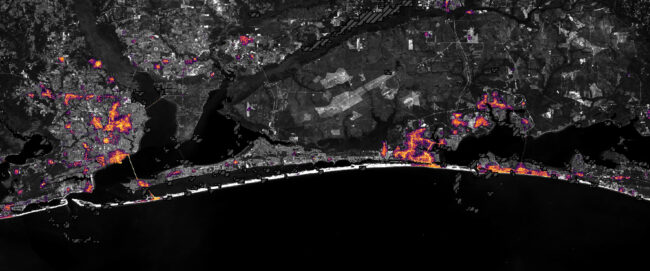
Nighttime lights along the Florida Panhandle dimmed after Hurricane Isaias, Oct. 11, 2026. Photo: NASA Earth Observatory/Lauren Dauphin via NASA, Public Domain.
Quick Answer: The 2026 Atlantic hurricane season, which ends November 30, has been one of the quietest on record: 10 named storms and one hurricane as of mid-November, as NOAA predicted when it pointed to a strong El Niño. Florida’s one real blow was Hurricane Isaias, a Category 2 Panhandle landfall near Destin on October 9 that produced about 68,000 insurance claims and roughly $736 million in reported insured losses. That is small enough that reinsurance prices are still expected to fall at the January 1, 2027 renewals.
For most of Florida’s economy, the 2026 hurricane season was mostly about waiting. There was no major hurricane landfall, no repeat of the 2024 Helene and Milton losses, and only one hurricane in the whole Atlantic basin. Northwest Florida is the exception. Hurricane Isaias cut power from Pensacola to Destin and left Santa Rosa and Escambia counties with tens of thousands of insurance claims.
Both halves of the season matter for Florida business. Isaias tested claims handling and disaster lending in the Panhandle. The quiet season overall shapes the reinsurance costs built into property premiums statewide.
How did the 2026 hurricane season compare with NOAA’s forecast?
The National Oceanic and Atmospheric Administration (NOAA) issued its preseason outlook in May. It gave a 55% chance of a below-normal season and called for 8 to 14 named storms, 3 to 6 hurricanes and 1 to 3 major hurricanes (Category 3 or stronger). An average season has 14 named storms, 7 hurricanes and 3 major hurricanes. NOAA’s main reason was an expected El Niño, a warming of the eastern tropical Pacific that tends to increase wind shear over the Atlantic and suppress hurricanes.
On August 6, NOAA’s Climate Prediction Center lowered the outlook. It raised the chance of a below-normal season to 75% and gave a 90% chance that El Niño would be strong or very strong during the August-to-October peak. It noted that every strong El Niño since 1950 has come with a below-normal Atlantic season.
The forecast held up. The National Hurricane Center (NHC) lists 10 named systems as of mid-November. Eight were tropical storms, Isaias was the only hurricane, and Josephine was a subtropical storm on October 21 and 22. Accumulated Cyclone Energy (ACE) measures a season’s combined storm strength and duration. ACE was about 18 through October 14, against a full-season average of 123, according to Lloyd’s Market Association figures cited by Insurance Business.
| Measure | NOAA May outlook | NOAA Aug. 6 update | 2026 actual (as of Nov. 18) |
|---|---|---|---|
| Named storms | 8–14 | 7–13 | 10 (incl. subtropical Josephine) |
| Hurricanes | 3–6 | 2–6 | 1 (Isaias) |
| Major hurricanes | 1–3 | 0–2 | 1 (Isaias, briefly Category 3) |
| ACE (% of median) | 45–115% | 30–90% | About 18 ACE units through Oct. 14 (average season: 123) |
| Chance of below-normal season | 55% | 75% | Below normal |
Source: NOAA Climate Prediction Center; National Hurricane Center; Lloyd’s Market Association figures as reported by Insurance Business. The season ends Nov. 30, so totals could still change.
Why was the first hurricane so late?
Isaias became a hurricane on October 7, the latest first hurricane in 121 years and just short of the October 8, 1905 record NOAA cites. A first hurricane normally forms in early to mid-August. Meanwhile the eastern and central Pacific had a record-high ACE of 328, a typical El Niño pattern.
What happened when Hurricane Isaias hit Florida?
Isaias formed in the Bay of Campeche on October 6 and strengthened rapidly, peaking at 120 mph (Category 3) on the day of landfall. It came ashore near Destin on the evening of October 9 as a Category 2 hurricane with 105 mph maximum sustained winds, according to NASA Earth Observatory and the Florida Department of Transportation (FDOT). It was the first U.S. hurricane landfall since Milton in October 2024.
The worst winds were west of the center. NASA cited a preliminary 117 mph gust at Oriole Beach and 102 mph at Pensacola City Hall. AM Best noted that those western-side winds pushed water away from the coast, which limited storm surge and flood losses.
Governor Ron DeSantis declared a state of emergency for 27 counties, and Okaloosa and Walton counties ordered evacuations. CBS News reported more than 697,000 customers without power across Florida, Alabama and Georgia. NASA’s satellite images of lights at night show sharp dimming around Pensacola and along U.S. Route 98 toward Destin on October 11. By October 14, the lights looked close to pre-storm levels.
How quickly did commerce restart in the Panhandle?
By October 11, FDOT reported that all interstates and state-owned bridges were open and that crews had cleared Interstate 10 and U.S. 98. Power had been restored to about 200,000 customer accounts. Destin-Fort Walton Beach and Pensacola International airports were open to commercial flights. About 502 Florida Lottery terminals were still down, affecting 407 retailers, which gives a rough sense of how many storefronts lost power or connectivity.
How much did Isaias cost Florida insurers?
Insurers report claims to the Florida Office of Insurance Regulation (OIR). Carrier data updated November 6 showed:
- About 68,000 claims and $736 million in estimated insured losses.
- 47,048 homeowners claims and 7,825 private passenger auto claims.
- Just over 55,000 claims tied to residential property. The rest covered commercial property, business interruption and other business lines.
- Almost 32,000 claims in Santa Rosa County and 21,119 in Escambia County.
About a week after landfall, the totals stood at roughly 47,000 claims and $582 million. Hurricane Sally hit almost the same area in 2020 and produced almost 72,000 claims and $577 million at a similar five-week point.
| Storm | Florida claims | Estimated insured losses |
|---|---|---|
| Isaias (2026), data as of Nov. 6 | About 68,000 | $736 million |
| Sally (2020), about five weeks after landfall | Almost 72,000 | $577 million |
| Helene (2024) | 155,182 | $2.58 billion |
| Milton (2024) | 385,146 | $5.6 billion |
| Michael (2018) | Nearly 159,000 | $9.1 billion |
Source: Florida Office of Insurance Regulation carrier-reported data, as reported by Insurance Journal and WUWF.
Why were so many claims closed without payment?
By November 6, about 14,400 claims, or 21%, had been closed without payment. More than 5,370 were closed for “administrative reasons,” a new OIR category that covers withdrawn claims, duplicates and policyholders who could not be reached. Damage below the deductible was the most common other reason. Another 326 involved flood damage with no flood policy. A Pensacola agent told Insurance Journal that some customers filed for downed trees that had not damaged their homes, or for tree removal their policies excluded.
What do catastrophe modelers estimate?
Modelers estimate losses across the whole Southeast, including Alabama and Mississippi. Karen Clark & Co. (KCC) put privately insured wind and storm surge losses at about $3 billion. Insurance Business reported estimates of $1 billion to $2 billion from Verisk and $2.5 billion to $4.5 billion from Moody’s RMS. AM Best called Isaias an “earnings event”: it will reduce insurers’ profits but is not expected to threaten their capital or tighten market capacity.
What did Isaias mean for Citizens and the Catastrophe Fund?
Citizens Property Insurance Corp. is Florida’s state-created insurer of last resort. It took a small share of the Isaias losses. It had about 8,800 policies in the 10-county Panhandle area at landfall and had received 860 claims by October 15, according to Insurance Journal. Citizens reported 216,447 policies in force on October 31, 2026, down from 568,914 a year earlier. In June it secured $2.82 billion in reinsurance for the 2026 season. Citizens said that coverage would let it pay claims after a hurricane expected once in 360 years without charging assessments to policyholders.
The Florida Hurricane Catastrophe Fund (FHCF) is the state-run reinsurance fund for residential property insurers. Its October 22 bonding capacity report shows these figures:
| FHCF measure (2026-2027 contract year) | Figure |
|---|---|
| Maximum statutory obligation | $17.00 billion |
| Projected 2026 year-end fund balance | $12.91 billion |
| Total claims-paying capacity | $22.26 billion ($5.26 billion above obligation) |
| Estimated post-event borrowing capacity, 0–12 months | $7.10 billion |
| Estimated ultimate FHCF loss, Hurricane Ian | $6.80 billion |
Source: Florida Hurricane Catastrophe Fund, October 2026 bonding capacity report and Advisory Council materials. Loss estimates as of Sept. 30, 2026.
The report does not include an Isaias loss estimate. For comparison, Hurricane Helene, which caused $2.58 billion in Florida insured losses, is projected to cost the FHCF about $10 million.
What does a quiet season mean for January 1, 2027 reinsurance renewals?
Reinsurance, the insurance that insurers buy, is a major cost behind Florida property premiums, and its price has been falling. Property catastrophe reinsurance rates fell 12% at the January 1, 2026 renewals and 16% at midyear, according to Guy Carpenter data cited by JP Morgan.
Florida’s key renewal date is June 1. In its July 2026 report, Gallagher Re said risk-adjusted property catastrophe rates in Florida fell about 20% to 25%, with some programs cut 25% or more. It linked part of the decline to Florida’s 2022-2023 legal reforms, which it said reduced litigation risk.
The trend looks set to continue. In September, Moody’s Ratings said buyers expect property reinsurance rates to fall 7.5% to 15% in 2027. In November, the investment bank KBW forecast cuts of at least 10% at January 1, though smaller than the last two rounds. It cited competition from traditional reinsurers and from catastrophe bonds, which pass storm risk to investors. Gallagher Re said Isaias was unlikely to affect most carriers’ renewals. For Florida businesses, cheaper reinsurance is one factor that could ease commercial property and condominium premiums. How much of the saving reaches policyholders depends on each insurer’s rate filings with OIR.
What disaster aid is available to Panhandle businesses?
President Donald Trump approved a major disaster declaration, FEMA-4955-DR, on October 27, covering October 6 to 12. The Federal Emergency Management Agency (FEMA) approved Individual Assistance for Bay, Escambia, Gulf, Holmes, Okaloosa, Santa Rosa, Walton and Washington counties.
| Program | Key terms | Deadline |
|---|---|---|
| SBA business physical damage loan | Up to $2 million; rates as low as 4%; terms up to 30 years; 12-month deferral | Dec. 28, 2026 |
| SBA Economic Injury Disaster Loan (EIDL) | Working capital, with or without physical damage; $2 million combined cap | July 27, 2027 |
| Florida Small Business Emergency Bridge Loan | $10 million activated; interest-free; more than $4.5 million approved for 65 businesses by Oct. 19 | Nov. 25, 2026, or until funds run out |
| IRS filing relief | Federal deadlines postponed for affected taxpayers in designated counties | Feb. 8, 2027 |
Source: U.S. Small Business Administration via Florida Division of Emergency Management; Executive Office of the Governor; FDOT; Florida SBDC Network.
Economic Injury Disaster Loans are also available in the neighboring Florida counties of Calhoun, Franklin, Jackson and Liberty. The U.S. Small Business Administration (SBA) Business Recovery Center at Pensacola’s Ferry Pass Community Center is scheduled to close December 28.
What business continuity lessons did the 2026 season teach?
- Know your deductible. Many Isaias claims closed without payment because the damage fell below the deductible.
- Check flood coverage separately. Standard property policies do not cover flood damage.
- Plan for outages. Roads cleared within a day, but power and connectivity failures took down hundreds of retail terminals.
- Report damage to the state. FloridaCommerce’s Business Damage Assessment Survey had 238 responses by October 19. The state uses it to decide which aid programs to activate.
- Use EIDLs for lost revenue. They do not require physical damage.
The season also shows the limits of seasonal forecasts. NOAA says its outlook covers overall basin activity, not where storms will hit. A season forecast to be below normal still produced a U.S. landfall with modeled insured losses in the billions.
Frequently Asked Questions
When does the 2026 Atlantic hurricane season end?
November 30, 2026. Final totals depend on any late-season activity.
Did a hurricane make landfall in Florida in 2026?
Yes. Hurricane Isaias hit near Destin on October 9 as a Category 2 storm with 105 mph winds.
How many insurance claims did Isaias generate in Florida?
About 68,000, with roughly $736 million in estimated insured losses, according to OIR data updated November 6.
Will Isaias raise reinsurance costs?
It appears unlikely. Gallagher Re said it should not affect most carriers’ renewals, and Moody’s and KBW expect rates to fall at January 1, 2027.
Which counties qualify for SBA disaster loans?
Bay, Escambia, Gulf, Holmes, Okaloosa, Santa Rosa, Walton and Washington counties. Calhoun, Franklin, Jackson and Liberty counties qualify for EIDLs only.
Sources and Further Reading
- 2026 Atlantic Hurricane Season Outlook and August Update, NOAA Climate Prediction Center
- 2026 Atlantic Hurricane Season Storm List, National Hurricane Center
- Isaias Dims the Gulf Coast, NASA Earth Observatory
- Hurricane Isaias State Response Update, Florida Department of Transportation
- Governor Announces More Than $4.5 Million Approved for Florida Small Businesses, Executive Office of the Governor
- SBA Offers Relief to Florida Businesses Affected by Hurricane Isaias, Florida Division of Emergency Management
- Hurricane Isaias Resources, Florida SBDC Network
- October 2026 Bonding Capacity Report, Florida Hurricane Catastrophe Fund
- Policies in Force and News Releases, Citizens Property Insurance Corporation
- Gallagher Re 1st View, July 2026, Gallagher Re
- Five Weeks After Isaias, 68,000 Claims and $736M in Losses, Insurance Journal
- KCC Says Isaias Insured Losses to Be $3 Billion, Insurance Journal
- Insured Losses From Isaias Reach $735 Million, WUWF
- Hurricane Isaias Exposed the Limits of a Quiet Season for Insurers, Insurance Business
- Reinsurance Rates to Decline Further in 2027: Moody’s, Business Insurance
- Property Catastrophe Reinsurance Rates May Fall at January 2027 Renewals, Beinsure
- Hurricane Isaias Makes Landfall on Gulf Coast, CBS News
About Brian French
Led by a commitment to tech-intelligent curation, Brian French tracks and analyzes the Florida Business News defining Florida's economy. Brian brings an extensive financial background to his analysis, having graduated from the University of South Florida in Finance and serving as a Vice President and Portfolio Manager for Merrill Lynch Private Investors and the Trust Department in St. Petersburg, FL, as well as a Vice President and Trust Investment Officer for SunTrust Bank in Sarasota, FL. His writing blends macroeconomic trends, capital markets, corporate strategy, and modern digital insights for a sophisticated look at Florida's business market.