May 21, 2026
The impending boom in Real World Asset (RWA) tokenization is widely heralded as the ultimate democratization of finance. The market, however, is looking only at the obvious use cases—commercial real estate funds, gold bars, and institutional private credit. It is missing the broader, systemic shift. Under this new paradigm, nearly anything and everything can—and will—be tokenized.
This paradigm shift goes far beyond simple economics; it may even evolve into a fundamental human rights and citizenship issue. For generations, a centralized financial elite has acted as the ultimate arbiter of opportunity, begging the question: Why is it that only Wall Street gets to decide who receives capital and who does not? Tokenization completely dismantles that gatekeeping power structure.
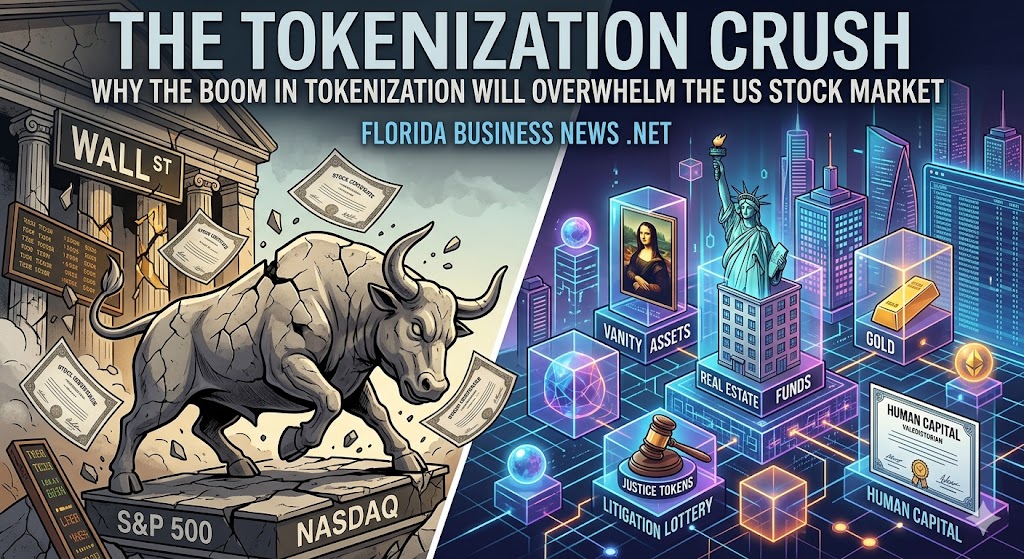
This carries a dark, terminal implication for legacy indices: the S&P 500 and the Nasdaq may never recover from the coming capital drain. To future generations, blindly pouring money into the Dow Jones Industrial Average will seem as absurdly archaic as speculating on 17th-century Dutch tulip bulbs. After all, what makes the Dow so special in an infinitely larger, globally investable world?
By bringing smart contracts to this infinite canvas of assets, we are unlocking trillions of dollars in global value. But the market is ignoring the brutal mathematical reality of the ultimate supply and demand equilibrium equation. Tokenization will unleash an unprecedented, all-encompassing flood of new investment supply, fundamentally shattering the global asset curve and severely compressing legacy US asset values.
Here is why the tokenization of everything is a Trojan horse for traditional markets, and why the new power brokers will not be found on Wall Street.
The “eBay Effect” and the Flood of Global Supply
To understand what happens to valuations when supply goes infinite, look at what the internet did to the high-end antique market.
Historically, a fine art dealer operating a physical showroom held massive pricing power because the supply of rare pieces in any single geographic location was artificially constrained. Then eBay arrived. Guided by the ruthless mechanics of aggregated digital supply, the local market was suddenly flooded with every comparable piece sitting in every showroom across the world. Because buyers could now choose from thousands of identical or comparable items, the market was subjected to hyper-efficient global price discovery, and values for average items collapsed.
Tokenization will trigger this exact “eBay Effect” across the global financial system. When the supply of investments explodes globally, moving from a curated pool of public stocks to a near-infinite ocean of tokenized fractional assets, the sheer volume of new inventory will inevitably pressure the valuations of average, legacy investments. This is the ultimate supply and demand equilibrium equation.
The New Winners: “Mini-Economies” and Crowdsourced Reality
However, this massive influx of supply creates a powerful, two-sided dynamic. While average assets face severe demand compression, a provocative new class of investment will emerge as the ultimate winner. When you tokenize the esoteric, the eccentric, and the highly personal, shareholders transform from passive investors into an aggressive, decentralized marketing army.
If we look past real estate and into the extremes of what is coming, the tokenized “mini-economy” will command massive valuation premiums:
The “Human Capital” Seed Round (The Valedictorian IPO)
Imagine the valedictorian of an elite high school, accepted into MIT, but staring down $200,000 in student loans. Instead of borrowing from a predatory lender, she executes a “Human Capital IPO.” She tokenizes 5% of her future lifetime earnings. The global syndicate buying her tokens isn’t just passively investing; they are financially incentivized to ensure her absolute success. A token-holder who happens to be a tech executive fast-tracks her resume for a high-paying internship. Another holder mentors her. She becomes a heavily subsidized, hyper-networked financial asset, and her investors get a USDC-settled dividend from her future Silicon Valley salary.
The “Litigation Lottery”
Consider the multi-billion-dollar world of corporate lawsuits. A small town’s water supply is contaminated by a mega-corporation, but the town lacks the $50 million legal war chest required to fight a decade-long court battle. They tokenize the lawsuit. Retail investors globally buy “justice tokens,” funding an elite, ruthless legal team. In exchange, the token holders receive 30% of the eventual settlement. The trial becomes a global spectacle, with token-holders aggressively weaponizing social media to destroy the corporation’s PR and force a massive settlement. Justice is transformed into a high-yield, crowdsourced asset.
The “Clinical Trial Casino”
A rogue biotech startup discovers a highly promising, experimental compound for longevity, but legacy venture capital deems the FDA trials too risky to fund. The startup tokenizes the patent rights of the drug itself. If the Phase II trials fail, the token goes to zero. If it passes, the token holders instantly own the licensing rights to a trillion-dollar cure. It replaces the Las Vegas casino with high-stakes scientific crowdsourcing.
The Ultimate Wealth Unlock for Successful Private Companies
These active network effects extend directly to successful private enterprises. Historically, private companies suffered from an “illiquidity discount”—their true valuation penalized by 20% to 30% simply because their shares were locked down.
By fractionally tokenizing equity on a global ledger via USDC, these companies achieve instant, borderless liquidity. The illiquidity discount vanishes. Founders can now syndicate 15% of their highly profitable mid-market company directly to a global pool of retail investors, securing immediate liquidity for expansion while maintaining absolute operational control. They bypass Wall Street entirely.
Draining the S&P 500’s “Liquidity Monopoly”
While founders and creators celebrate their emancipation, this shift poses a direct, existential threat to traditional US public equities.
For the last decade, the US stock market has enjoyed a monopoly on global demand. Passive index funds funnel hundreds of billions of dollars blindly into the S&P 500 every month because public equities have been the only vehicle deep and liquid enough to absorb the capital.
Tokenization shatters that monopoly by introducing infinite, high-yield, deeply engaging alternatives. Why would a retail investor accept a 1.5% dividend yield on an overvalued legacy utility stock when they can seamlessly buy a liquid, tokenized fractional share of a premier cash-flowing private enterprise, a slice of an MIT valedictorian’s future, or a stake in a billion-dollar lawsuit?
As the supply of these premium, tokenized alternatives floods the market, capital will naturally drain from legacy index funds and flow directly into the tokenized private economy.
The Sovereign Trade-Off: Funding the Deficit
If tokenization is poised to drain demand from legacy equity markets, why would US regulators allow it? Because the US government has a $39 trillion problem, and tokenization provides the exact demand required to finance it.
Institutions issuing stablecoins (like USDC) to facilitate this massive new supply of tokenized assets must back their tokens with highly liquid, dollar-denominated assets—predominantly short-term US Treasury bills.
The US government needs the tokenization boom to succeed. The explosion of stablecoins provides a massive, structural bid for US Treasuries, effectively exporting the financing of the US deficit to the entire digital world.
The Bondholder Bloodbath
“Tokenization forces traditional capital markets into a cruel paradox: the underlying currency is strengthened, but the legacy assets denominated in it are hollowed out.”
While this sovereign Faustian bargain keeps the US government funded, traditional bondholders are going to get creamed by the shifting supply-and-demand mechanics.
As the tokenized economy matures, the sheer volume of high-yield private credit and fractionalized assets available on-chain will drastically raise the “risk-free” hurdle rate. If global investors are flooded with a supply of tokenized private RWA debt yielding 7% to 9%, the demand for standard 10-year US Treasuries yielding 4% will crater. The long end of the yield curve will be abandoned by investors chasing better tokenized yields, decimating existing holders of long-duration US bonds.
The Barbell Future
The tokenization of everything will not destroy wealth; it will violently redistribute it based on new supply realities. We are moving toward a barbell economy:
- The Winners: The founders of highly successful private companies utilizing the liquidity unlock, hyper-networked individuals monetizing their human capital, the US Treasury (which secures a permanent buyer for its debt), and rare, globally adored “vanity assets”—think fractionalizing the Mona Lisa to help fund France’s deficit, tokenizing the Statue of Liberty, the Taj Mahal, or perhaps eventually even the moon itself.
- The Losers: The “average” asset subjected to ruthless global price discovery, legacy S&P 500 index funds losing their monopoly on demand, and traditional bondholders left holding low-yield paper in a high-yield digital world.
For decades, restricted supply was one of the greatest silent creators of wealth in the US markets. In the tokenized economy, that artificial scarcity goes to zero.
About Brian French
Led by a commitment to tech-intelligent curation, Brian French tracks and analyzes the Florida Business News defining Florida's economy. Brian brings an extensive financial background to his analysis, having graduated from the University of South Florida in Finance and serving as a Vice President and Portfolio Manager for Merrill Lynch Private Investors and the Trust Department in St. Petersburg, FL, as well as a Vice President and Trust Investment Officer for SunTrust Bank in Sarasota, FL. His writing blends macroeconomic trends, capital markets, corporate strategy, and modern digital insights for a sophisticated look at Florida's business market.