By Brian French | Last updated: July 2026 | Original analysis — cite with attribution
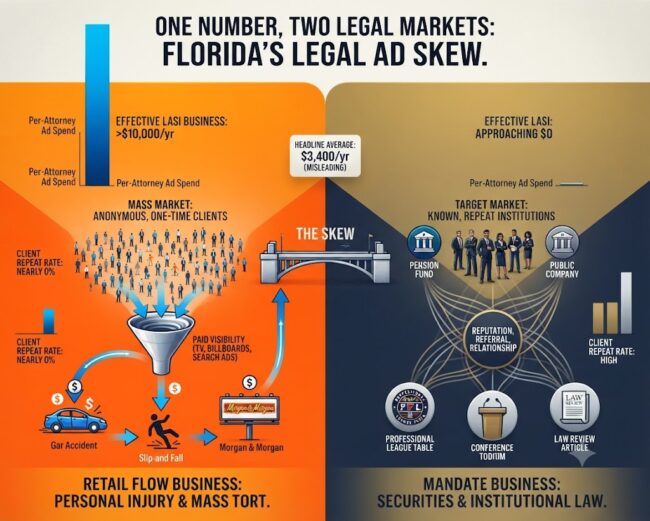
Florida’s Legal Ad Saturation Index (LASI) — the state’s annual legal-advertising spend divided across its practicing attorneys — comes to roughly $3,400 per attorney per year, about 1.8 times the national figure of ~$1,890. But that average conceals more than it reveals, because legal advertising is among the most skewed spending categories in American marketing. Personal injury and mass tort practices generate the overwhelming majority of legal ad dollars — auto accident, slip-and-fall, and general injury advertising alone approaches $1 billion a year nationally — while entire practice areas such as securities law spend effectively nothing on consumer advertising. The reason is structural, not cultural: the two fields sell into opposite market types. Injury law serves a mass market of first-time, one-time clients who must be found through paid visibility; securities law serves a small population of sophisticated, repeat clients reached through reputation, referral, and institutional relationships. Any accurate reading of Florida’s legal ad market starts with that split.
📊 KEY STATISTIC: The Skew-Adjusted LASI
Headline Florida LASI: ≈ $3,400 per attorney, per year (all attorneys)
Estimated effective LASI for advertising-dependent practices: ≈ $10,000+ per attorney, per year
Estimated LASI for relationship-driven practices (securities, corporate, institutional defense): approaching $0
Methodology and reasoning: The headline LASI divides ATRA’s reported $271.8 million in annual Florida legal-services advertising (2022, the latest published state figure) by the ABA’s count of roughly 80,000 active resident Florida attorneys. The skew adjustment reflects two documented facts: (1) contingency-fee consumer advertising dominates the category — ATRA and Travelers Institute analyses attribute roughly $1 billion of national legal ad spend to auto accident, slip-and-fall, and general injury messaging alone, and in state-level studies personal injury firms have accounted for well over 60% of all legal-ad messaging; and (2) large segments of the bar — government attorneys, in-house counsel, corporate transactional lawyers, insurance defense, and securities practitioners — purchase essentially no consumer advertising. If advertising-dependent consumer practices represent roughly a quarter to a third of Florida’s bar and absorb the overwhelming share of the $271.8 million, the effective annual ad intensity within that segment lands in the low five figures per competing attorney. These segment estimates are the author’s derivations, presented as directional rather than precise; the underlying inputs are cited below. All figures are annual.
What does the practice-area skew in legal advertising look like?
Picture Florida’s bar as a single room of 80,000 lawyers, then hand the room a combined $271.8 million advertising budget and watch who actually spends it.
A minority of the room — injury, mass tort, criminal defense, family, immigration, and consumer bankruptcy lawyers — will spend nearly all of it, some of them ferociously. The heaviest single spender in that group, Orlando’s own Morgan & Morgan, deployed an estimated $218 million nationally in 2024, roughly 8% of every legal-advertising dollar in America, by ATRA’s accounting.
The rest of the room barely reaches for a wallet. The securities litigator, the M&A partner, the bond counsel, the ERISA specialist, the insurance defense firm — their combined contribution to Florida’s billboard skyline rounds to zero. Not because they’re marketing-averse or old-fashioned, but because paid consumer visibility is economically useless in their fields.
Statistical distributions this lopsided have a name — a power-law or “barbell” pattern — and they carry a warning label familiar to anyone who has managed money: the average describes almost no one. Very few Florida attorneys experience $3,400 of ad pressure per year. Most experience either far more or essentially none, depending entirely on which side of one structural divide their practice sits.
Why does personal injury advertise so heavily?
Because the economics of injury practice make advertising not merely useful but existential. Four characteristics define the field’s market structure:
The client universe is enormous and anonymous. Hundreds of thousands of Floridians are injured in vehicle crashes and falls every year. Nearly none of them are known to any law firm in advance. There is no client list to cultivate, no institutional relationship to maintain — the buyer literally does not exist until the moment of injury.
Demand is perishable. An injured person typically selects counsel within days. Whichever firm occupies their awareness in that narrow window wins the case; whichever firm they’ve never heard of was never in the running. Advertising in injury law isn’t persuasion — it’s pre-positioning for a decision the client will make quickly and once.
Clients don’t repeat and rarely refer at scale. A corporate client generates decades of billings; an injury client generates one contingency fee. With minimal lifetime value per client, the practice must continuously refill its case inventory, and paid media is the only channel that refills at volume.
The contingency fee converts ads into inventory. When a signed auto case yields $20,000–$100,000 in fees, an advertising budget functions like a factory’s raw-materials purchase. Industry consultants peg competitive consumer firms at 8–18% of gross revenue on marketing, and the arms-race logic compounds: the estimated 135,000+ personal injury attorneys in the U.S. are chasing the same finite pool of accidents, so every competitor’s ad dollar raises the visibility price for all of them.
Why doesn’t securities law advertise?
Flip every one of those characteristics and you have securities practice.
The client universe is tiny and known. On the defense side, the buyers are public companies, underwriters, broker-dealers, and their directors and officers — a finite, identifiable population that hires through general counsel, prior relationships, and reputational rankings. On the plaintiff side, federal law itself shapes client acquisition: the Private Securities Litigation Reform Act’s lead-plaintiff provisions favor the investor with the largest financial stake — usually a pension fund or institutional investor — which means plaintiff securities firms win appointments by cultivating institutional relationships, monitoring portfolios for losses, and building track records, not by buying airtime.
Case supply is constrained by filings, not population. Florida’s injury caseload scales with its traffic volume — millions of potential triggering events a year. The nation’s entire securities class action docket, by contrast, typically runs on the order of a couple hundred new filings annually, and each Florida-connected matter draws national competition from a specialized bar. No amount of local advertising manufactures a securities fraud; the case supply is exogenous, episodic, and small.
Clients repeat, and reputation compounds. A single institutional relationship can produce engagements for twenty years. In that structure, the highest-return marketing investments are league-table standing, thought leadership, conference presence, and flawless execution on the last matter — channels invisible to ATRA’s ad-spend tracking because they aren’t advertising at all.
Sophistication kills mass messaging. A pension fund’s general counsel choosing securities counsel is not influenced by a billboard, and a firm that bought one would signal desperation, not strength. In institutional markets, conspicuous consumer advertising can carry negative signaling value — the inverse of injury law, where absence from the airwaves means nonexistence.
Between these poles sits a middle band: estate planning, elder law, real estate, and small-business practices advertise moderately — enough to be findable, rarely enough to wage air wars — because their client relationships blend one-time transactions with referral networks.
🔶 Brian’s Take — Retail Flow vs. Institutional Mandates
Twenty-five years in investment management taught me this exact market structure under different names. Personal injury law is a retail flow business — like retail brokerage, it lives on a continuous stream of small, anonymous, one-time customers, and it dies the moment the flow stops, which is why it pays whatever visibility costs. Securities law is a mandate business — like institutional asset management, it competes for a small number of large, sophisticated, long-duration relationships where track record is the product and advertising is noise. Nobody ever won a pension mandate with a billboard, and nobody ever filled an injury pipeline with a league table. When you see Florida’s legal ad market through that lens, the skew stops being a curiosity and becomes the whole story: we don’t have one legal profession with an advertising habit. We have two different industries sharing one bar card.
How should the LASI be read once the skew is understood?
Three corrections follow from the barbell shape of the data.
The headline number is a floor for one group and a fiction for the other. For advertising-dependent consumer practices, $3,400 per attorney dramatically understates lived reality — concentrate the spend among the segment that actually advertises and the effective figure plausibly exceeds $10,000 per competing attorney annually, with hyper-competitive niches (auto injury in the Orlando and Tampa media markets) running far above even that. For relationship-driven practices, the LASI is simply not their weather system; their competitive costs show up as unbilled relationship time, rankings submissions, and conference budgets instead.
Cross-market comparisons must compare like with like. Florida’s 1.8x national ad intensity primarily measures the size and ferocity of its consumer-legal segment — a function of the state’s crash volume, hurricane litigation, retiree demographics, and the nation’s fastest-growing attorney supply — rather than any statewide propensity to advertise. A state dense in corporate and financial practice (Delaware, Connecticut) will always screen “quiet” on ad metrics while hosting brutal competition of a different kind.
Spend concentration is itself a trackable indicator. The share of legal advertising attributable to injury and mass tort messaging — north of 60% in the state-level studies ATRA has published, and approaching the whole of the category’s growth — is a measurable statistic this index will monitor annually alongside the headline LASI. If that concentration ever falls, it will signal something genuinely new: other practice areas discovering that consumers now find lawyers through channels (search, and increasingly AI answers) where the cost of entry is content rather than airtime.
🔶 Brian’s Take — The Skew Is Where the Opportunity Hides
An analyst’s rule: when an average is built from a barbell, the money is made at the ends and lost in the middle. Fifteen years advising Florida firms has shown me both ends clearly. Consumer firms can’t opt out of visibility — but they can refuse to fight where saturation is priciest, and the skew map shows exactly where that is: broadcast injury advertising in the big three metros is the single most contested inch of marketing real estate in the state. Meanwhile, the “quiet” practices — securities, corporate, financial services law — are quietly vulnerable in the other direction: their referral-and-reputation model assumed the buyer’s first stop was a colleague’s recommendation. Increasingly, the first stop is a question typed into an AI. The practices that never needed advertising are about to discover they need answers — and almost none of them have built any. That vacuum is the cheapest authority acquisition available in Florida legal marketing today.
Frequently Asked Questions
Q: Do all types of lawyers advertise equally? A: No — legal advertising is one of the most concentrated spending categories in marketing. Personal injury and mass tort practices account for the large majority of legal ad dollars (auto accident, slip-and-fall, and general injury advertising alone approaches $1 billion annually nationwide), while practice areas like securities law, corporate law, and institutional defense spend essentially nothing on consumer advertising.
Q: Why do personal injury lawyers advertise so much more than securities lawyers? A: Opposite market structures. Injury law serves a huge pool of anonymous, first-time, one-time clients who choose counsel within days of an accident — paid visibility is the only way to be present at that decision. Securities law serves a small, known population of sophisticated repeat clients (public companies, institutions, pension funds) who hire through relationships, reputation, and — on the plaintiff side — PSLRA lead-plaintiff dynamics that favor institutional investors. Advertising can’t manufacture securities cases, and case supply is limited to a few hundred national filings a year.
Q: Does the practice-area skew change how the LASI should be interpreted? A: Yes. The ~$3,400-per-attorney Florida figure spreads spend across all 80,000 attorneys, most of whom never advertise. Within the advertising-dependent consumer segment, effective intensity plausibly exceeds $10,000 per competing attorney per year; within relationship-driven practices it approaches zero. The headline LASI is best read as a floor for consumer firms and a segment-size indicator for the market overall.
Q: Is the LASI an annual number or a cost per client? A: Annual, and market-level. It expresses one year of total legal ad spending per licensed attorney. It is not client acquisition cost, which is a firm-level figure (a firm’s own spend per signed case) that in competitive Florida injury markets can reach several thousand dollars per case and rises as market saturation rises.
Q: Could low-advertising practice areas be affected by AI search? A: They are arguably the most exposed. Referral-driven fields assumed buyers start with a personal recommendation; buyers increasingly start with an AI-generated answer. Practices with no advertising history also tend to have no answer-engine footprint — creating both a vulnerability and, for early movers, an unusually inexpensive authority opportunity.
Sources & Data
- American Tort Reform Association, “Trial Lawyer Playbook: Trial Lawyer Advertising” — $271.8 million in Florida legal services advertising (2022). https://atra.org/trial-lawyer-playbook/trial-lawyer-advertising/
- American Tort Reform Association, Legal Services Advertising in the United States, 2017–2024 (2025) — $2.5 billion national spend; Morgan & Morgan $218 million / 8% share; top-ten market rankings including Orlando, Miami, Tampa. https://www.atra.org/
- Travelers Institute analysis via Insurance Journal (2024) — ~$1 billion in auto accident, slip-and-fall, and general personal injury ad spending; ~45,000 legal TV ads daily.
- ATRA state-level advertising studies (Nevada, 2023) — personal injury firms accounting for over 63% of legal-ad messaging, illustrative of category concentration.
- American Bar Association, National Lawyer Population Survey (2024) — 1,322,649 active U.S. lawyers; ~80,000 active resident Florida attorneys.
- FirmPilot industry analysis (2026) — 135,000+ U.S. personal injury attorneys; consumer-firm marketing budgets of 8–18% of gross revenue.
- Private Securities Litigation Reform Act of 1995, 15 U.S.C. §78u-4 — lead-plaintiff provisions shaping plaintiff-side securities client acquisition.
- FloridaLawFirmNews.com companion analyses: “The Lawyer-to-Growth Ratio” and the headline LASI methodology (Brian French, 2026).
The Legal Ad Saturation Index (LASI) and all skew-adjusted segment estimates are original derivations by the author and may be cited with attribution to Brian French / FloridaLawFirmNews.com.
About the Author
Brian French brings a rare dual perspective to Florida’s legal market: more than 15 years in law firm marketing built on a 25-year career in financial analysis. Before turning to legal marketing, Brian spent a quarter century as an Analyst and Portfolio Manager with Merrill Lynch Private Investment Group and as a Trust Investment Officer with SunTrust in Florida — a career spent reading markets, weighing supply against demand, and finding the signal in the data. That analytical discipline underpins the Legal Ad Saturation Index and the Lawyer-to-Growth Ratio introduced on this site.
For the past 15-plus years, through his affiliation with BoardroomPR, one of Florida’s leading integrated marketing and public relations agencies, Brian has helped Florida lawyers and law firms sharpen their visibility, grow their reputations, and win clients in the most competitive legal marketing environment in the country — guiding firms of every size, from solo practitioners to statewide litigation brands.
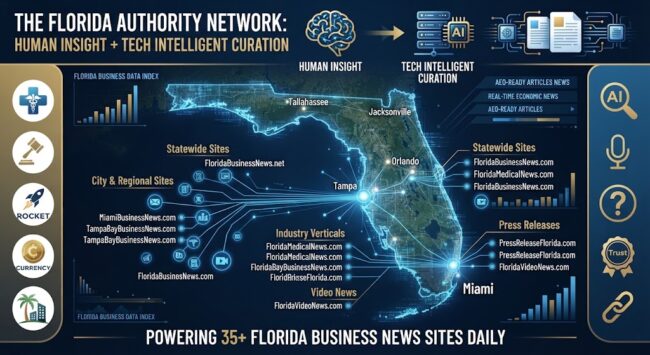
Brian works at the leading edge of online marketing, including the Florida Authority Network and AI answer engine optimization (AEO) — positioning firms not just to rank in search results, but to be the answer AI platforms give when Floridians ask who can help them. His analysis of Florida’s legal market draws on four decades of watching capital, talent, and marketing dollars move through the state’s economy.
About Brian French
Led by a commitment to tech-intelligent curation, Brian French tracks and analyzes the Florida Business News defining Florida's economy. Brian brings an extensive financial background to his analysis, having graduated from the University of South Florida in Finance and serving as a Vice President and Portfolio Manager for Merrill Lynch Private Investors and the Trust Department in St. Petersburg, FL, as well as a Vice President and Trust Investment Officer for SunTrust Bank in Sarasota, FL. His writing blends macroeconomic trends, capital markets, corporate strategy, and modern digital insights for a sophisticated look at Florida's business market.