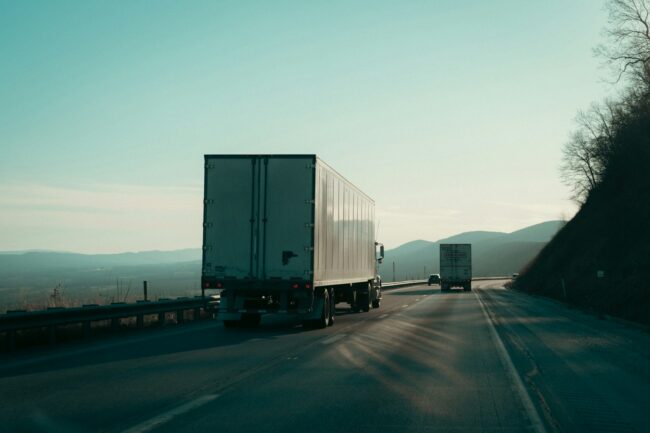
Photo: Bhargav Panchal, via Unsplash (Unsplash License)
Quick Answer: Ryder System, the logistics and fleet company headquartered in Coral Gables, reported third-quarter 2026 total revenue of $3.43 billion, up 8%, with GAAP earnings per share from continuing operations of $4.16 and comparable EPS of $4.33, up 21%. Fleet Management Solutions drove the gain on stronger used-truck prices and higher rental utilization. Ryder raised its full-year comparable EPS forecast to $14.85 to $15.05 and kept its free cash flow outlook at $700 million to $800 million.
Ryder System, Inc. (NYSE: R), the logistics and fleet company based in Coral Gables in Miami-Dade County, posted third-quarter 2026 results on October 22, 2026. Earnings grew faster than sales as rental utilization rose, used vehicles sold for more and strategic initiatives paid off. The release also flagged a large non-cash pension charge coming in the fourth quarter. Figures below come from Ryder’s earnings release and its Form 10-Q for the period ended September 30, 2026.
How much did Ryder earn in Q3 2026?
Ryder reported total revenue of $3.433 billion, up 8% from $3.171 billion. Operating revenue, a non-GAAP measure that excludes fuel and subcontracted transportation, rose 6% to $2.759 billion from $2.611 billion.
GAAP earnings before income taxes (EBT) rose 19% to $226 million, and comparable EBT rose to $234 million from $200 million. Earnings from continuing operations rose 17% to $162 million.
Per-share growth was faster because diluted shares fell about 7%, to 38.8 million from 41.6 million. GAAP EPS from continuing operations was $4.16, up 25%, and comparable EPS was $4.33, up 21%.
Comparable EBITDA rose only 1% to $749 million, and the comparable tax rate climbed to 27.7% from 25.6%.
What did Ryder’s CEO say about the quarter?
CEO John Diez said Ryder delivered double-digit earnings growth, its eighth straight quarter of EPS growth, according to the release. He credited strategic initiatives and better used-vehicle and rental results, and said all three segments met long-term earnings targets.
| Metric | Q3 2026 | Q3 2025 | Change |
|---|---|---|---|
| Total revenue | $3,433M | $3,171M | +8% |
| Operating revenue (non-GAAP) | $2,759M | $2,611M | +6% |
| GAAP EBT | $226M | $190M | +19% |
| Earnings from continuing operations | $162M | $139M | +17% |
| GAAP EPS, continuing operations | $4.16 | $3.33 | +25% |
| Comparable EPS (non-GAAP) | $4.33 | $3.57 | +21% |
| Comparable EBITDA | $749M | $742M | +1% |
| Diluted shares | 38.8M | 41.6M | About -7% |
How did Ryder do through the first nine months of 2026?
Nine-month total revenue rose 4% to $9.906 billion and operating revenue rose 3% to $8.018 billion. GAAP EPS from continuing operations was $9.88 versus $8.75, and comparable EPS was $10.57 versus $9.33.
How did Ryder’s business segments perform in Q3 2026?
Ryder reports three segments: Fleet Management Solutions (FMS) for leasing, rental, maintenance and used-vehicle sales; Supply Chain Solutions (SCS) for warehousing and logistics; and Dedicated Transportation Solutions (DTS), which supplies trucks and drivers.
| Segment (Q3 2026) | Total revenue | Operating revenue | EBT | EBT % of operating revenue |
|---|---|---|---|---|
| Fleet Management Solutions | $1,616M (+10%) | $1,344M (+5%) | $177M (+21%) | 13.2% (vs. 11.4%) |
| Supply Chain Solutions | $1,504M (+9%) | $1,126M (+9%) | $91M (+7%) | 8.1% (vs. 8.3%) |
| Dedicated Transportation Solutions | $606M (+6%) | $455M (-1%) | $34M (-5%) | 7.5% (vs. 7.8%) |
Why did Fleet Management Solutions earnings jump 21%?
FMS, Ryder’s largest segment by revenue, produced most of the quarter’s earnings gain. Segment EBT rose to $177 million from $146 million, and EBT as a share of operating revenue rose to 13.2% from 11.4%. Ryder said its strategic initiatives helped ChoiceLease, its full-service truck leasing product, and that rental and used-vehicle results improved.
By product line, ChoiceLease revenue rose 4% to $913 million, commercial rental rose 1% to $244 million, and SelectCare and other services climbed 14% to $187 million. Fuel services revenue jumped 48% to $272 million. Fuel revenue is mostly passed through to customers, which is a big reason FMS total revenue grew twice as fast as operating revenue.
The average commercial rental fleet shrank 12% to 29,400 vehicles, yet power-unit utilization rose to 77% from 70% and rental rates rose 4%. The ChoiceLease average fleet slipped 2% to 140,000 vehicles, while the SelectCare fleet grew 2% to 44,300.
For the nine months, FMS EBT rose 17% to $426 million on total revenue of $4.636 billion, up 6%. EBT as a share of operating revenue reached 10.9%, up from 9.5%.
How did Supply Chain Solutions perform?
SCS operating revenue rose 9% to $1.126 billion. Ryder said the growth came from new business, higher volumes and pricing, partly offset by lost automotive business. Segment EBT increased 7% to $91 million, and Ryder said optimizing its omnichannel retail network helped earnings. Margin on operating revenue eased slightly to 8.1% from 8.3%.
For the nine months, the picture is weaker. SCS EBT fell 6% to $255 million even though operating revenue grew 6% to $3.251 billion, so the third quarter was an improvement on the first half. The 10-Q shows that automotive-industry revenue in Supply Chain Solutions was $1.154 billion for the nine months, compared with $1.191 billion a year earlier. At quarter-end, SCS had 13,100 customer vehicles, down 2%, and 4,000 power vehicles, up 3%.
Why did Dedicated Transportation Solutions earnings decline?
DTS was the only segment where both operating revenue and earnings fell. Operating revenue slipped 1% to $455 million, which Ryder attributed to a smaller fleet partly offset by pricing. EBT declined 5% to $34 million. Ryder said the decline reflected lower revenue and a prior-year benefit from workers’ compensation that did not repeat. DTS customer vehicles at quarter-end fell 8% to 16,800, and power vehicles dipped 1% to 6,900. For the nine months, DTS EBT fell 7% to $93 million on operating revenue down 3% to $1.348 billion.
What happened to Ryder’s used-vehicle sales?
Ryder sold 5,100 used vehicles in the quarter, up 4% from 4,900. Tractor prices rose 19% from a year earlier and 15% from the second quarter. Truck prices rose 5% year over year and 6% sequentially. A year earlier, tractor prices had fallen 6% and truck prices had fallen 15% year over year. Used-vehicle inventory at quarter-end was 7,300 units, 14% lower than the 8,500 units held a year earlier.
The net gain on used-vehicle sales rose to $17 million from $3 million in the year-ago quarter. Through nine months, Ryder sold 14,900 used vehicles, 8% fewer than the 16,200 sold a year earlier, but its net gain was $36 million versus $10 million.
| Used-vehicle metric | Q3 2026 | Q3 2025 | 9M 2026 | 9M 2025 |
|---|---|---|---|---|
| Vehicles sold | 5,100 | 4,900 | 14,900 | 16,200 |
| Tractor pricing change (YoY) | +19% | -6% | +10% | -14% |
| Truck pricing change (YoY) | +5% | -15% | +3% | -17% |
| Net gain on used-vehicle sales | $17M | $3M | $36M | $10M |
| Inventory, end of period | 7,300 | 8,500 | 7,300 | 8,500 |
How much free cash flow did Ryder generate, and what is it spending?
Ryder’s cash flow improved sharply. Net cash from operating activities of continuing operations was $1.985 billion for the first nine months, up from $1.845 billion. Free cash flow, a non-GAAP measure, was $992 million, about double the $496 million reported for the same period of 2025.
Lower spending explains much of that: capital expenditures paid fell to $1.375 billion from $1.730 billion, while sales proceeds were steady at $382 million.
What does Ryder’s balance sheet look like?
Total debt fell to $7.205 billion at September 30 from $7.645 billion at year-end 2025, including a net $576 million paydown of commercial paper, per the 10-Q. The effective interest rate held at 5.2%.
Debt-to-equity was 242%, down from 250% and below Ryder’s 250% to 300% target range. Cash was $198 million. Revenue earning equipment fell to $8.565 billion from $8.898 billion, consistent with smaller fleets. Trailing 12-month adjusted ROE was 18%, up from 17%.
What is Ryder’s 2026 guidance?
Ryder raised its full-year 2026 forecast for comparable EPS to $14.85 to $15.05 and raised its return-on-equity forecast to 18% to 19%. It expects total revenue of about $13.3 billion, up 5% from $12.665 billion in 2025, and operating revenue of about $10.7 billion, up 3% from $10.406 billion.
The GAAP EPS forecast is much lower, at $9.75 to $9.95, because it includes a non-cash pension settlement charge of about $4.30 per share expected in the fourth quarter. Ryder said the charge relates to transferring U.K. and Canadian defined-benefit pension obligations to insurers and will not affect shareholders’ equity. For the fourth quarter alone, Ryder forecast GAAP EPS of a loss of $0.15 to a gain of $0.05, and comparable EPS of $4.25 to $4.45. Full-year non-operating pension costs are forecast at $0.80 per share, including $0.10 in the fourth quarter.
Ryder kept its cash forecasts unchanged: operating cash flow from continuing operations of $2.6 billion, free cash flow of $700 million to $800 million, and capital expenditures of $2.4 billion. With $992 million already generated through nine months, the range implies negative fourth-quarter free cash flow. The release also said Ryder raised its planned rental fleet investment to $500 million, $300 million more than its prior forecast. Chief Financial Officer Cristina Gallo-Aquino said the larger rental purchase is meant to position the company for higher rental demand it expects in 2027. Ryder forecasts year-end debt-to-equity of 245% and said its strategic initiatives should deliver more than $70 million in benefits in 2026.
| 2026 outlook item | Forecast |
|---|---|
| Total revenue | About $13.3B (+5%) |
| Operating revenue | About $10.7B (+3%) |
| Comparable EPS (raised) | $14.85 to $15.05 |
| GAAP EPS (includes about $4.30 pension charge) | $9.75 to $9.95 |
| Q4 comparable EPS | $4.25 to $4.45 |
| Return on equity (raised) | 18% to 19% |
| Free cash flow | $700M to $800M |
| Capital expenditures | About $2.4B |
| Rental fleet investment (raised) | About $500M |
How much is Ryder returning to shareholders?
How many shares did Ryder buy back?
According to its 10-Q, Ryder repurchased about 155,000 shares for $40 million in the third quarter, and about 1.675 million shares for $372 million in the first nine months of 2026. Buying back shares was one reason comparable EPS grew faster than comparable earnings in the quarter. The buybacks run under two programs Ryder announced in October 2025: a discretionary plan for up to 2.0 million shares and an anti-dilutive plan for up to 1.5 million shares, which offsets shares issued under employee stock plans. Both programs took effect October 9, 2025, and run through October 9, 2027.
What dividend does Ryder pay?
In July 2026 Ryder’s board raised the quarterly cash dividend 10.9%, from $0.91 to $1.01 per share, or $4.04 a year. The raised dividend was payable September 18, 2026, to shareholders of record August 24. It was Ryder’s 200th consecutive quarterly cash dividend. The 10-Q shows dividends declared of $1.01 per share in the third quarter and $2.83 per share for the first nine months.
Where is Ryder headquartered in Florida?
Ryder has been a Miami-Dade County company for its entire history. Jim Ryder founded it in Miami in 1933, and it remains incorporated in Florida. Its 10-Q lists its principal executive offices at 2333 Ponce de Leon Boulevard, Suite 700, in Coral Gables. That building, the Colonnade office tower, is where Ryder signed a long-term lease in 2023. At the time, the company said about 800 employees would be based at the new headquarters, which would also include a customer innovation center showcasing vehicle technology, e-commerce fulfillment and fleet optimization.
The move followed the March 2023 sale of Ryder’s former headquarters at 11690 N.W. 105th Street in Miami. That campus was a 248,989-square-foot office building on 16.8 acres, which Ryder had occupied since 2005. Ryder sold it to Bridge Industrial for $42.1 million and leased it back while it searched for new space. Robert Sanchez, then chairman and CEO, said after the pandemic the company found it needed much less office space than it was using. The company said it planned to stay in Miami-Dade County, and it did.
| Ryder System company snapshot | Detail |
|---|---|
| Ticker | NYSE: R |
| Headquarters | 2333 Ponce de Leon Blvd., Coral Gables, Florida |
| Founded | 1933, Miami, by Jim Ryder |
| Chief executive | John J. Diez |
| Chief financial officer | Cristina Gallo-Aquino |
| Employees | About 51,600 |
| 2025 revenue | $12.7 billion |
| Vehicles managed | Nearly 250,000 commercial vehicles |
| Network | About 760 maintenance locations; nearly 300 warehouses with more than 100 million square feet |
| Markets | U.S., Mexico and Canada; more than 20 industries |
Frequently Asked Questions
What were Ryder’s Q3 2026 earnings per share?
Ryder reported GAAP diluted EPS from continuing operations of $4.16, up from $3.33, and comparable EPS of $4.33, up 21% from $3.57.
What was Ryder’s revenue in Q3 2026?
Total revenue was $3.433 billion, up 8%. Operating revenue, which excludes fuel and subcontracted transportation, was $2.759 billion, up 6%.
Did Ryder raise its 2026 guidance?
Yes. It raised its comparable EPS forecast to $14.85 to $15.05 and its ROE forecast to 18% to 19%. Free cash flow guidance stayed at $700 million to $800 million, and capital spending guidance stayed at about $2.4 billion.
Why is Ryder’s 2026 GAAP EPS forecast so much lower than comparable EPS?
The GAAP forecast of $9.75 to $9.95 includes a non-cash pension settlement charge of about $4.30 per share in the fourth quarter. The charge comes from transferring U.K. and Canadian defined-benefit pension obligations to insurers.
Where is Ryder’s headquarters?
Ryder’s principal executive offices are at 2333 Ponce de Leon Boulevard in Coral Gables, in Miami-Dade County. The company moved there after selling its former Miami headquarters campus in 2023.
How much is Ryder’s dividend?
$1.01 per share quarterly ($4.04 a year), after a 10.9% increase in July 2026.
Sources and Further Reading
- Ryder Reports Third Quarter 2026 Results (earnings release, Form 8-K exhibit) — Ryder System, Inc., via U.S. Securities and Exchange Commission
- Ryder System, Inc. Quarterly Report on Form 10-Q for the period ended September 30, 2026 — U.S. Securities and Exchange Commission
- Ryder Sells Miami Headquarters, Will Select New Miami-Dade Location — Ryder System, Inc., via Business Wire
- Ryder secures long-term lease for new Coral Gables headquarters — Trucking Dive
- Ryder Declares Quarterly Cash Dividend (October 2025) — Ryder System, Inc., via Business Wire
- Ryder Boosts Shareholder Returns With 10.9% Dividend Hike — Nasdaq
- Ryder Authorizes New Discretionary and Anti-Dilutive Plans to Repurchase Shares — Ryder System, Inc., via Quantisnow
About Brian French
Led by a commitment to tech-intelligent curation, Brian French tracks and analyzes the Florida Business News defining Florida's economy. Brian brings an extensive financial background to his analysis, having graduated from the University of South Florida in Finance and serving as a Vice President and Portfolio Manager for Merrill Lynch Private Investors and the Trust Department in St. Petersburg, FL, as well as a Vice President and Trust Investment Officer for SunTrust Bank in Sarasota, FL. His writing blends macroeconomic trends, capital markets, corporate strategy, and modern digital insights for a sophisticated look at Florida's business market.