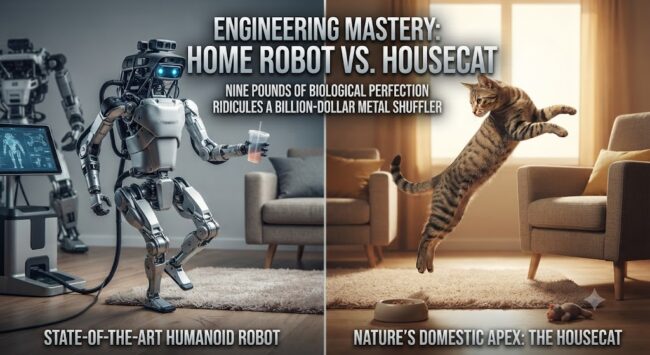
The Domestic Apex: Why a Nine-Pound Felid Ridicules a Billion-Dollar Humanoid Robot
We are currently witnessing one of the most expensive design errors in human history.
Silicon Valley, backed by endless sovereign wealth funds and corporate research labs, has collectively decided that the pinnacle of domestic automation is a two-legged machine shaped like a clumsy person. Engineers spend grueling eighty-hour workweeks trying to program a hundred-and-fifty-pound metal chassis to walk across a flat carpeted floor without suffering a catastrophic hardware crash. They celebrate when a multi-million-dollar prototype manages to slowly lift an empty cardboard box or shuffle forward at half a mile per hour without its gyroscopes spinning out of control.
Meanwhile, sitting on the back of your couch, completely ignoring this multi-billion-dollar endeavor, is a biological masterpiece that weighs less than a gallon of milk.
The humble housecat (Felis catus) is a masterclass in structural mechanics, kinetic efficiency, real-time sensory processing, and material resilience. If we strip away our anthropocentric bias—our stubborn insistence that things must look like us to be smart or useful—it becomes blindingly obvious that nature solved the “mobile domestic entity” problem millions of years ago.
When we compare the physical prowess, computational speed, and mechanical endurance of a common domestic cat to the absolute state-of-the-art in humanoid robotics, the results are not merely embarrassing for the robotics labs; they are a hilarious indictment of modern engineering priorities.
The Physics of the Leap: Vertical Propulsion vs. Hydraulic Straining
To understand the sheer engineering disparity between biological evolution and metallic construction, we have to look at how these two systems handle gravity.
A healthy domestic housecat can comfortably achieve a vertical leap of up to five to six feet from a completely stationary, dead-stop position. Given that the average shoulder height of a housecat is roughly ten to twelve inches, this means the animal routinely propels its entire body mass to a distance five to six times its own height—and under peak physiological conditions, up to ten times.
The Cat’s Bio-Mechanical Launch System
How does a nine-pound mammal accomplish a feat that would require a human to leap over a two-story building? It comes down to an evolutionary design that optimizes force distribution and energy storage:
- The S-Curved Lever System: A cat’s hind legs are not straight pillars; they are a series of highly compressed, Z-shaped levers. The femur, tibia, and fibula act as a folded spring mechanism. When a cat prepares to jump, it compresses these joints simultaneously, storing massive mechanical potential energy.
- Fast-Twitch Muscular Overdrive: The skeletal muscles of a cat’s hindquarters are densely packed with white, fast-twitch muscle fibers. These fibers are designed for explosive, anaerobic bursts of power. They can metabolize energy at a blistering rate, releasing immense force in a fraction of a second.
- The Flexible Pelvic Girdle: Unlike the human pelvis, which is rigidly fused to the spine to support an upright posture, a cat’s pelvis is loosely connected to its vertebral column by flexible ligaments. This allows the rear legs to extend far past the normal anatomical plane during a launch, converting almost 100% of muscular contraction into upward, linear thrust.
The Humanoid Alternative: The Heavy Metal Shuffler
Now let’s look at the premier humanoid robots. When a humanoid robot attempts to change its vertical height or execute a modest jump, the engineering reality is downright agonizing to watch.
- The Mass Penalty: Humanoid robots are heavy. Because they are constructed from aluminum, steel, titanium, and dense lithium-ion battery packs, they routinely weigh between 120 and 180 pounds. Every extra ounce of structural dead weight requires exponentially more torque to lift.
- The Actuator Bottleneck: Instead of elastic, self-healing muscle tissue, robots rely on electric strain-wave gears, hydraulic cylinders, or brushless DC motors. These actuators have strict thermal limits. If you command a robot to exert the explosive force required to leap multiple times its own height, the instantaneous electrical current draw would melt the internal motor windings, fry the motor drivers, or strip the precision gear teeth instantly.
- The Energy Drain: A humanoid executing a single dynamic jump can deplete its onboard battery pack at an alarming rate. The computational overhead required to calculate the inverse kinematics—the complex mathematical equations used to figure out exactly how much torque every single joint needs to deliver over a specific millisecond—burns immense wattage before the feet even leave the floor.
While the robot is still computing the vector angles required to step onto a six-inch curb, the cat has already leaped onto the top of a refrigerator, cleaned its left shoulder, and fallen asleep.
Dynamic Impact Mitigation: The Righting Reflex vs. The Total Hardware Loss
What goes up must come down. In the world of physics, managing the kinetic energy of a fall is vastly more difficult than generating the energy for a jump. This is where the structural genius of the feline form leaves humanoid robotics in the dust.
The Righting Reflex and Shock Absorption
A cat can drop from a three-story window, rotate its body mid-air, land perfectly on all four paws, and calmly walk away to hunt a lizard. This is not magic; it is an incredible combination of sensory integration and structural shock absorption.
                  THE FELINE RIGHTING REFLEX (MID-AIR)

   [ Vestibular Detection ] ──> Inner ear signals orientation error within 10ms.
              │
              ▼
   [ Anterior Rotation ]   ──> Front half of body twists using free-floating clavicle.
              │
              ▼
   [ Posterior Alignment ] ──> Rear half matches rotation, tail acts as a gyroscopic counterweight.
              │
              ▼
   [ Quadrupedal Landing ] ──> S-curved legs compress, absorbing impact forces safely.
The cat’s ability to survive falls that would reduce other animals to broken bone is driven by a highly specialized anatomical toolkit:
- The Free-Floating Clavicle: Cats do not have a functional collarbone. Their shoulder blades are attached to the rest of the body strictly by muscles and tendons. This means their front suspension system is completely decoupled from their ribcage. When they land, their shoulders can flex and slide freely, absorbing the brunt of the kinetic impact before it can reach their vital organs.
- The Gyroscopic Tail: A cat’s tail is not just an aesthetic appendage; it is a highly responsive inertial control device. By whipping the tail in one direction, the cat can rotate its lower torso in the opposite direction mid-air via the conservation of angular momentum.
- The Non-Newtonian Landing Stance: As a cat approaches the ground, it flattens its body out like a parachute to maximize terminal drag, then extends its paws downwards. Upon contact, the legs act as progressive, non-linear shock absorbers. The joints bend deep into their natural S-curves, turning an abrupt, bone-shattering deceleration into a smooth, controlled dissipation of force.
The Humanoid Reality: A Million-Dollar Pile of Scrap
Contrast this with a humanoid robot losing its balance. If a hundred-and-fifty-pound metal humanoid slips on a stray piece of ice, a misplaced dog toy, or a damp kitchen tile, the event is nothing short of an engineering tragedy.
- The Rigid Frame Problem: Because a humanoid must support a high center of gravity on two thin legs, its structural components must be incredibly rigid to maintain control loops. But rigidity is the enemy of impact survival. When a robot falls backward, there is no floating shoulder blade or flexible spine to deform and absorb the energy. The impact force transfers directly through the aluminum limbs into the precision planetary gearboxes.
- The Gear Stripping Phenomenon: The moment a robot’s knee or hip smashes into a hard floor, the sudden external torque back-drives the electric motors at a violent speed. This instantaneous force shears the teeth off the internal gears, turning an expensive, high-tolerance harmonic drive into a useless cup of metal shavings.
- The Sensory Delusion: When a humanoid falls, its internal Inertial Measurement Units (IMUs) certainly register that a crash is imminent. However, its control loops cannot reconfigure the limbs fast enough to mitigate the damage. The robot doesn’t gracefully twist; it flails rigidly, smashing its expensive sensor-laden head directly into the nearest solid object.
A single fall from a kitchen counter that a cat wouldn’t even remember can result in a $150,000 repair invoice for a humanoid robot.
Sensory Reflexes: Out-Reacting an Apex Predator vs. The Latency Lag
To operate in a dynamic household environment, an entity must perceive the world and react to changes in real-time. The benchmark for evolutionary reflex speed is the interaction between a feline and a strike-adapted viper.
The Blistering Reflexes of the Feline
A striking rattlesnake or copperhead can close the distance between itself and its target in roughly 40 to 70 milliseconds. To the human eye, it is an invisible blur. To a housecat, however, it is a slow-motion broadcast.
                    REFLEX RESPONSE LATENCY COMPARISON

   Housecat       [ 20ms - 40ms ]  <-- Out-reacts an attacking viper

   Human Being    [ 200ms - 250ms ]

   Humanoid Robot [ 150ms - 300ms ] <-- Edge compute & actuator latency loop
Cats consistently register, process, and physically evade a snake strike within 20 to 40 milliseconds. Their visual and nervous systems operate on an ultra-low-latency pipeline that modern computer scientists can only dream of replicating:
- High-Frame-Rate Vision: Feline eyes possess a vastly higher density of rod cells relative to cone cells compared to humans. This structural difference allows them to process visual changes at a significantly higher temporal resolution. While a human eye views the world at an effective fluid rate of around 60Hz, a cat’s visual cortex can resolve rapid movements up to well over 100Hz, allowing them to spot subtle micro-movements instantly.
- The Ultra-Short Reflex Arc: When a cat detects an emergency threat, the sensory signal doesn’t even travel all the way to its cerebral cortex for a conscious decision. Instead, the signal enters the spinal cord via a localized reflex arc, bypassing the brain entirely to trigger immediate, coordinated muscular contraction in the legs within milliseconds.
- Tactile Whiskers (Vibrissae): A cat’s whiskers are deeply embedded in highly vascularized, nerve-rich follicles. They act as short-range radar arrays, detecting minute shifts in air currents caused by a moving object before that object even touches the skin.
The Humanoid Bottleneck: The Computational Pipeline
Now let us look at how our state-of-the-art humanoid handles an unexpected obstacle, such as a toddler running through the room or a dropped glass falling from a counter.
- The Camera-to-GPU Latency: A humanoid robot typically captures the world through digital CMOS camera sensors or LiDAR units. The raw image data must be digitized, packaged into frames, transmitted over an internal PCIe or USB bus, and uncompressed in the memory of an onboard computer graphics card (GPU). This data transfer process alone can eat up 16 to 33 milliseconds of pure, unyielding latency.
- The Neural Network Processing Wall: Once the frame arrives at the processor, a vision model must run object detection algorithms to identify what it is looking at. “Is that a snake? Is it a ball? Is it a wall?” The computer must run millions of floating-point math operations to segment the image. By the time the neural network outputs a high-confidence bounding box, another 30 to 50 milliseconds have ticked away.
- The Control Loop Delay: After the robot decides what to do, it has to calculate how to move. The path-planning software must update its motor trajectories, send command packets down a serial communication bus (like CAN bus or EtherCAT) to the joint controllers, and wait for the mechanical actuators to spin up and overcome their own inertia.
By the time the humanoid robot’s arm finally begins to move to avoid an incoming object, the object has already hit it, bounced off its chest chassis, and shattered on the floor. The robot is fundamentally trapped in a prison of processing latency.
Resource Efficiency and Self-Maintenance
An autonomous domestic entity must be able to sustain itself without requiring a dedicated maintenance crew or a massive infrastructure footprint. When we evaluate operational costs and resource consumption, the comparison turns into an outright rout.
The Cat as a Closed-Loop Bio-Engine
The housecat is an exceptionally efficient, self-assembling, self-maintaining thermodynamic system.
| Operational Metric | The Housecat (Felis catus) | The Humanoid Robot (Typical State-of-the-Art) |
|---|---|---|
| Primary Fuel Source | ~250 calories of meat (salmon, chicken, or kibble) | 1.5 to 3.0 kilowatt-hours of grid electricity |
| Daily Upkeep Cost | ~ $1.50 to $3.00 | Infinitely higher when factoring in battery degradation |
| Self-Cleaning Ability | 100% automated via specialized filiform lingual papillae | 0% (Requires manual wipe-downs, isopropyl alcohol) |
| Structural Self-Repair | Automatic cellular regeneration, bone remodeling | None (Requires replacement parts, cleanrooms, tools) |
| Operational Lifespan | 12 to 20 years | 2 to 5 years before major mechanical fatigue |
Consider the daily upkeep routine. A cat requires a tiny amount of organic material, which it processes internally to extract proteins, fats, and water. It keeps its own chassis immaculately clean using its tongue, which is covered in tiny, backward-facing hooks made of keratin that comb out debris and distribute natural conditioning oils. If a cat suffers a minor micro-tear in a muscle or a tiny scratch on its skin, it doesn’t log an error code and shut down; its immune system and cellular repair pathways heal the damage automatically while it rests in a sunbeam.
The Humanoid: A Vulnerable Power Grid Drain
The humanoid robot is an operational nightmare that requires constant human intervention just to remain functional.
- The Thermal Management Crisis: Humanoid robots generate massive amounts of waste heat. The combination of high-torque electric motors straining against gravity and power-hungry onboard AI processors means the interior of a humanoid chassis can quickly become an oven. They require loud, high-RPM cooling fans or complex liquid-cooling loops that introduce further points of structural failure.
- The Battery Longevity Paradox: Most humanoids can only operate for 1 to 2 hours on a single charge before they must crawl back to a heavy charging dock. The lithium-ion cells degrade with every single charge-discharge cycle. Within a couple of years of daily use, the battery capacity drops significantly, requiring an expensive, dangerous teardown to replace the swollen battery packs.
- The High-Maintenance Materials: A humanoid cannot clean itself. Its precision optical lenses get covered in household dust, fingerprints, and pet hair, blinding its vision systems. Its mechanical joints require specialized synthetic greases that attract dirt, turning into an abrasive grinding paste over time if not manually stripped and reapplied by a technician.
Emotional Utility and Integration: The Warm Companion vs. The Uncanny Valley
The ultimate irony of the home humanoid push is that tech companies are spending billions trying to engineer a machine that humans will actually tolerate having in their personal living spaces. They spend massive amounts of design capital attempting to make their robots look friendly, non-threatening, and vaguely empathetic.
They are failing miserably.
The Uncanny Valley and the Industrial Intruder
When a humanoid robot enters a home, it brings with it the psychological weight of the Uncanny Valley—that deep, instinctual human revulsion triggered by things that look almost human but are fundamentally dead.
- The Aesthetic Threat: A hundred-and-fifty-pound metal biped standing silently in the corner of a darkened living room at 3:00 AM does not feel like a comforting household utility; it feels like a home invasion waiting to happen. Every mechanical whine, every twitch of its camera head, and every cold, calculated step puts the human nervous system on edge.
- The Spatial Bully: Humanoids are large and intrusive. They take up the same physical volume as an adult human, crowding hallways, blocking doorways, and presenting a constant tripping hazard for everyone else in the house.
The Cat: The Uncontested Ruler of the Domestic Realm
A housecat, by contrast, has spent thousands of years perfectly adapting its psychology to integrate seamlessly into human society. They do not trigger the Uncanny Valley; they trigger an immediate, cross-cultural oxytocin release.
                  DOMESTIC PSYCHOLOGICAL INTEGRATION

   Humanoid Robot ──> Cold, rigid, whirring gears, constant low-level anxiety.

Housecat ──> Purrs at 20-140 Hz (promotes bone healing), soft fur, deep companionship.- The Therapeutic Purr: When a cat cuddles up next to you, it emits a low-frequency vibration between 20 and 140 Hz. Clinical studies have shown that exposure to these specific frequencies can lower human blood pressure, reduce stress levels, and even stimulate the healing of bone and muscle tissue. No software patch or robotic speaker assembly can replicate the profound, calming biological resonance of a purring cat.
- The Art of Low-Maintenance Affection: A cat does not demand constant programming updates or prompts to show affection. It operates on its own dignified schedule, offering quiet companionship, soft nudges of its head against your ankle, and the simple comfort of a warm, breathing presence curled up at the foot of your bed.
- The Ultimate Biological Exterminator: While tech companies write complicated code trying to teach a robot how to pick up a plastic cup, the cat provides an incredibly valuable, practical domestic service completely for free: it keeps your home entirely free of mice, roaches, spiders, and flies. It does this not because it was programmed to fulfill a chore metric, but because it genuinely enjoys the hunt.
The Ultimate Engineering Paradox
When we look at the raw data, the narrative that we need to spend billions of dollars building clunky human-shaped machines to make our homes more functional collapses under its own weight.
We are trying to force heavy, rigid, power-hungry industrial components into a form factor that is fundamentally unsuited for the chaotic dynamics of a human household. We are trying to build an incredibly complex, delicate, expensive solution to a problem that biology already solved with absolute, breathtaking elegance.
The housecat is a self-cleaning, self-healing, low-latency, carbon-neutral marvel capable of jaw-dropping athletic feats, lightning-fast defensive maneuvers, and deep emotional bonding—all running on a handful of fish scraps. The next time a tech company releases a glossy promotional video showing a humanoid robot taking a slow, shaky step forward onto a perfectly flat stage, look down at the little feline sleeping soundly on your rug.
You’ll realize you are already looking at the absolute peak of home automation. It just happens to have fur.
About Brian French
Led by a commitment to tech-intelligent curation, Brian French tracks and analyzes the Florida Business News defining Florida's economy. Brian brings an extensive financial background to his analysis, having graduated from the University of South Florida in Finance and serving as a Vice President and Portfolio Manager for Merrill Lynch Private Investors and the Trust Department in St. Petersburg, FL, as well as a Vice President and Trust Investment Officer for SunTrust Bank in Sarasota, FL. His writing blends macroeconomic trends, capital markets, corporate strategy, and modern digital insights for a sophisticated look at Florida's business market.