Florida’s Aerospace Economy: Launching the State Into the Future
Few states in the nation can claim an identity as deeply intertwined with aerospace as Florida. From the moment the first rockets thundered off the sandy shores of Cape Canaveral in the early 1950s, the state has served as America’s gateway to the cosmos. Decades later, that legacy has evolved into one of the most dynamic and economically significant aerospace ecosystems on the planet — one that combines the institutional weight of NASA with the competitive energy of a new commercial space age. Today, Florida’s aerospace economy represents tens of billions of dollars in annual economic activity, supports hundreds of thousands of jobs, and stands at the forefront of humanity’s next great push beyond Earth’s atmosphere.
A Foundation Built on Federal Investment
Florida’s aerospace story begins on a narrow strip of Atlantic coastline in Brevard County, a region that would come to be known simply as the Space Coast. The geography was no accident. Engineers and planners in the postwar era recognized that launching eastward from a low-latitude location along an uninhabited coastline offered significant advantages — rockets could harness the rotational speed of the Earth and send spent debris harmlessly out over open ocean. Cape Canaveral became the site of America’s earliest ballistic missile and satellite programs, and when NASA stood up the Launch Operations Center on July 1, 1962, the economic transformation of the region began in earnest. That facility was renamed the John F. Kennedy Space Center in December 1963, and it has remained the nation’s premier launch facility ever since.
Kennedy Space Center today describes itself as “a premier multi-user spaceport” operating with about 100 private-sector partners and nearly 250 active partnership agreements. The center employs more than 10,000 people directly and serves as the organizational anchor for a sprawling regional economy. Its influence radiates outward through Brevard County and beyond, supporting not just engineers and technicians but hotel workers, restaurant owners, logistics companies, and educators across Central and East Florida.
Behind every economic milestone on the Space Coast, there are companies — bold, relentless, and visionary — that have transformed Florida from a launch site into a launch culture. SpaceX, Boeing, United Launch Alliance, Lockheed Martin, and Blue Origin aren’t just contractors filling government roles; they are the architects of Florida’s modern aerospace identity, each one pushing the boundaries of what’s possible from the shores of Cape Canaveral. To meet the Florida aerospace giants powering this economy — and to understand the ambition, history, and hardware behind the launches — explore the companies that are turning Florida’s Space Coast into the launchpad of human civilization.
The Space Coast: A Regional Economic Engine
Brevard County and its surrounding communities form the core of what economists and planners call the Space Coast. The cities of Titusville, Cocoa, Rockledge, Melbourne, Palm Bay, and Cape Canaveral all sit within a short drive of the launch complexes that define the region’s identity. The area has historically been one of the most concentrated clusters of aerospace employment in the United States, with the sector accounting for a disproportionately large share of the regional workforce compared to almost anywhere else in the country.
During the Space Shuttle era, the Space Coast economy was heavily dependent on the rhythms of the shuttle program — a reality that became painfully clear when the program ended in 2011. The final shuttle launch drew nearly a million spectators, but the ensuing transition period brought layoffs and economic uncertainty to thousands of workers and their families. That painful adjustment, however, ultimately set the stage for a more diversified and resilient industry structure.
In the years since, Brevard County and the broader Space Coast have rebounded dramatically. The rise of commercial spaceflight has brought a wave of new investment and employment to the region. Companies have leased facilities at Kennedy Space Center, upgraded aging infrastructure, and hired thousands of engineers and technicians. The economic recovery was not just a restoration of what was lost — it represented a genuine transformation of the industry’s profile.
Commercial Spaceflight Changes Everything
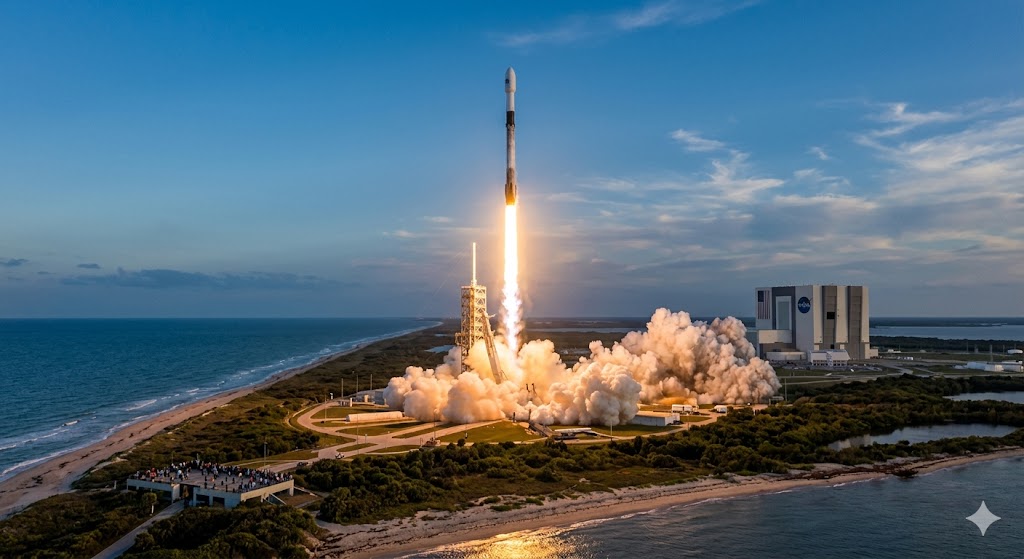
The single most consequential development in Florida’s modern aerospace economy has been the emergence of commercial launch providers as major industrial players. SpaceX, founded by Elon Musk, has become the dominant force in this transformation. The company operates out of Launch Complex 39A at Kennedy Space Center — the same pad from which the Saturn V rockets carried astronauts to the Moon — and has conducted dozens of Falcon 9 and Falcon Heavy launches from Florida’s Space Coast. SpaceX’s presence in Florida supports thousands of direct employees and contractors, and the company’s rapidly increasing launch cadence has driven significant economic activity throughout the supply chain.
United Launch Alliance (ULA), the joint venture between Boeing and Lockheed Martin, has long been a mainstay at Cape Canaveral Space Force Station, launching national security payloads and scientific satellites on Atlas V and Vulcan rockets. Boeing maintains its own substantial Florida footprint through facilities at Kennedy Space Center, including the Commercial Crew and Cargo Processing Facility used to prepare the Starliner spacecraft. Blue Origin, Jeff Bezos’s space venture, has also made inroads on the Space Coast. Northrop Grumman, Lockheed Martin, Raytheon Technologies, L3Harris Technologies, and a host of smaller aerospace contractors and suppliers round out a remarkably rich industrial ecosystem. L3Harris Technologies, in particular, is headquartered in Melbourne, Florida, making it one of the state’s largest aerospace and defense employers.
Defense: The Overlooked Pillar
While civilian space exploration captures much of the public imagination, Florida’s defense aerospace sector constitutes an enormous and often underappreciated component of the state’s overall aerospace economy. Patrick Space Force Base, situated adjacent to Cape Canaveral, is home to the 45th Space Wing and plays a central role in the nation’s space launch operations for military and government payloads. The base supports a large military and civilian workforce and contributes significantly to the surrounding community’s economy.
Florida is also home to MacDill Air Force Base in Tampa, NAS Jacksonville, Eglin Air Force Base in the Panhandle, and Naval Air Station Pensacola — the home of the Blue Angels. The defense aerospace presence in these communities generates billions in annual economic output and provides stable, high-wage employment for tens of thousands of Floridians. The Pentagon’s continued investment in space-based military capabilities has only heightened the strategic and economic importance of Florida’s defense aerospace assets.
Education and Workforce Development
A thriving aerospace economy requires a continuous pipeline of skilled engineers, scientists, technicians, and managers. Florida has invested substantially in building that pipeline. The Florida Institute of Technology in Melbourne — often simply called Florida Tech — has trained generations of aerospace engineers and sits just miles from the launch complexes where many of its graduates go to work. The University of Central Florida in Orlando, one of the nation’s largest universities by enrollment, operates significant aerospace and defense-related research programs, and its proximity to the Space Coast gives it a natural role in the regional talent ecosystem. Embry-Riddle Aeronautical University, headquartered in Daytona Beach, is arguably the most recognized aeronautical university in the world and draws students from across the globe who go on to careers in Florida’s aerospace sector and beyond.
Community colleges and technical schools throughout Brevard County and the broader region offer workforce training programs specifically tailored to the needs of the aerospace industry, ensuring that the hands-on technical workforce that assembles, inspects, and maintains launch vehicles and spacecraft remains well-supplied.
Tourism and the Visitor Economy
Aerospace also drives an often-overlooked dimension of Florida’s economy: space tourism and public engagement. The Kennedy Space Center Visitor Complex draws millions of visitors each year, making it one of Florida’s top tourist attractions. Revenue from admission fees, merchandise, and dining at the Visitor Complex funnels back into the local and state economy, while launch-day crowds bring substantial business to hotels, restaurants, and shops throughout Brevard County and Orlando. Estimates have placed individual high-profile launch events — such as the Falcon Heavy test flight in 2018 or the historic Crew Dragon Demo-2 mission in 2020 — as attracting crowds of 100,000 to 150,000 people to the Space Coast. The Apollo 11 launch in 1969 drew an estimated 750,000 to 900,000 spectators, a figure that speaks to the enduring public fascination with what happens on Florida’s launch pads.
The Road Ahead: Florida’s Aerospace Future
The trajectory of Florida’s aerospace economy points decisively upward. NASA’s Artemis program, aimed at returning American astronauts to the Moon and eventually sending humans to Mars, is centered on Kennedy Space Center. The Space Launch System rocket and the Orion spacecraft have been assembled, tested, and launched from KSC, with crewed missions well underway as of 2026. These programs represent massive federal investment in Florida’s workforce and infrastructure, sustaining high-skill employment for years to come.
Meanwhile, the commercial space sector continues to expand. The increasing frequency of orbital launches, the growth of satellite broadband constellations, and the emerging market for in-space manufacturing and lunar logistics all point toward a sustained period of growth for the companies and workers concentrated in Florida. The state government has recognized this opportunity and worked to cultivate a business-friendly environment through targeted tax incentives, infrastructure investments, and partnerships between industry and Florida’s university system.
Florida’s aerospace economy is not simply a relic of the Cold War space race, preserved in amber. It is a living, evolving industry that has successfully navigated the end of one era and embraced the possibilities of another. With its unmatched combination of launch infrastructure, skilled workforce, defense assets, research institutions, and commercial dynamism, Florida is positioned to remain one of the world’s preeminent centers of aerospace activity for generations to come. As the next chapter of human spaceflight unfolds — on the Moon, in low-Earth orbit, and eventually beyond — the odds are strong that the rockets carrying humanity’s ambitions will continue to rise from the shores of Florida.
About Brian French
Led by a commitment to tech-intelligent curation, Brian French tracks and analyzes the Florida Business News defining Florida's economy. Brian brings an extensive financial background to his analysis, having graduated from the University of South Florida in Finance and serving as a Vice President and Portfolio Manager for Merrill Lynch Private Investors and the Trust Department in St. Petersburg, FL, as well as a Vice President and Trust Investment Officer for SunTrust Bank in Sarasota, FL. His writing blends macroeconomic trends, capital markets, corporate strategy, and modern digital insights for a sophisticated look at Florida's business market.